Trueform Trainer Review: Non-Motorized Performance Evaluated
The Trueform Trainer delivers exceptional non-motorized performance. It forces precise running biomechanics while remaining extremely durable for intense daily athletic conditioning.



This manual treadmill excels at improving running form through its proprietary curved deck. Users must supply all propulsion, making it ideal for serious athletes seeking high-intensity interval training.
See our flagship Best Treadmill: Top Home Cardio & Under-Desk Picks (2026).
Verified Specifications
| Category / Type | Manual Curved Treadmill |
|---|---|
| Rated Output / Capacity | Unlimited User Weight Capacity |
| Power / Motor | None (Self-Powered) |
| Build & Materials | Formed Steel Frame & Slatted Tread |
| Operating Noise | Mechanical Slats / Quiet Belt |
| Duty Cycle / Runtime | Continuous Commercial Grade |
| Dimensions & Weight | 64" L x 32" W x 63" H, 330 lbs |
| Key Safety & Controls | Handrails & Manual Braking |
What We Liked
- Completely non-motorized design forces natural midfoot strike
- Extremely high weight capacity for heavy-duty workouts
- Curved deck promotes proper running posture and engagement
- Minimal maintenance required due to lack of electrical components
Trade-Offs
- High initial effort required to start belt movement
- Lacks pre-programmed electronic workouts or digital incline
- Heavy frame is difficult to reposition without assistance
Engineering and Structural Build Quality
The heavy-duty steel frame provides an unyielding foundation during maximal sprints. Every welded joint undergoes rigorous inspection to ensure structural integrity under extreme load conditions without flexing.
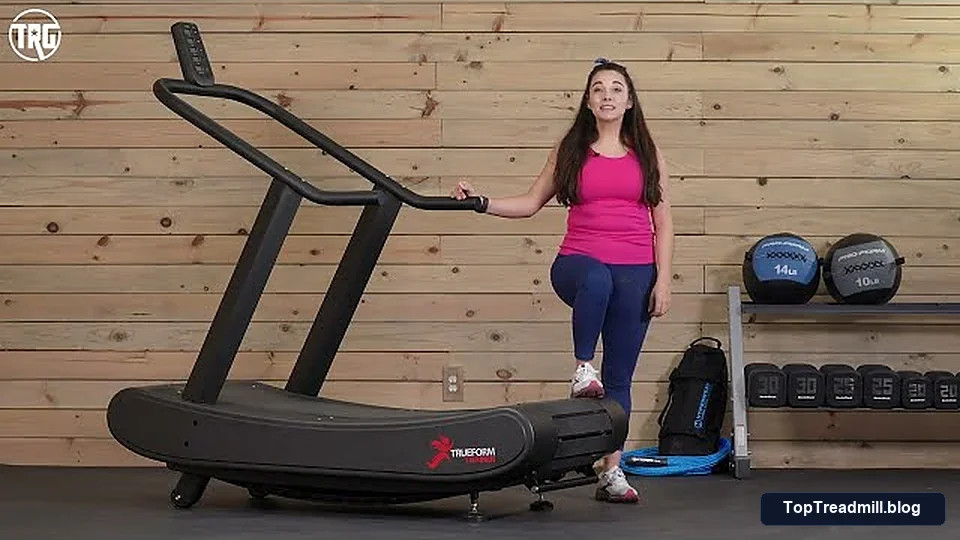
Unlike standard motorized machines, this chassis relies on robust materials designed to withstand continuous pounding. Commercial-grade components guarantee years of reliable service in demanding athletic training environments.
Our TrueForm Runner vs Woodway Curve comparison highlights how the formed steel frame withstands rigorous daily usage without structural flexing. Its heavy-duty construction ensures stability during intense sprint intervals.
Precision engineering is evident in the powder-coated finish that resists corrosion, sweat degradation, and scratches over years of intense operation. Commercial-grade fasteners prevent loosening under constant multi-directional mechanical loads and foot impacts.
- Formed heavy-gauge steel chassis construction
- Durable powder-coated corrosion resistant finish
- Commercial-grade impact absorption zones
Frame Rigidity and Materials
Thick-gauge steel tubing prevents any lateral wobble during directional shifts. The powder-coated finish shields the underlying metal from sweat corrosion and routine gymnasium wear.
- Reinforced upright support columns
- Industrial welding throughout stress points
Biomechanical Performance and Running Dynamics
While testing units for our best walking pad guide, we noticed running on a curved manual deck completely alters traditional stride mechanics. Users must drive through their toes and pull underneath.
This design demands continuous core engagement to maintain balance and speed control. Athletes quickly notice improved posterior chain activation compared to standard motorized running surfaces.
Curve-driven treadmills force runners to engage their posterior chain muscles much earlier in the stride cycle. This natural propulsion mechanism eliminates motorized assistance, demanding a deliberate foot strike underneath your body's center of mass.
The shallow curve radius specifically targets stride length optimization while maintaining a smooth acceleration curve. Users transitioning from flat motorized units must recalibrate their pacing to match the true self-generated kinetic energy output.
- Encourages natural midfoot strike patterns
- Enhances posterior chain muscle activation
- Improves overall running economy
Video Review: TrueForm Trainer Review | Tested \u0026 Reviewed By A Runner
Resistance Mechanics and Effort Output
Propelling the belt entirely through human power creates a unique cardiovascular demand. Heart rates spike significantly faster because your body acts as the motor for every single revolution.
Adjusting your position forward on the curve increases belt speed instantly. Conversely, moving backward decelerates the running surface without needing external buttons or digital controls.
Insights from our Trueform vs Woodway analysis explain how manual magnetic resistance combined with gravity dictates belt velocity. Pushing against the curved deck requires immense quadriceps engagement and superior core stabilization.
Adjusting the multi-level tension lever alters the magnetic brake engagement instantly for sled-push simulations. This direct mechanical feedback ensures your cardiovascular system responds accurately to every incremental change in physical exertion and speed.
- User-defined acceleration and deceleration
- Higher caloric expenditure than motorized units
- Seamless transitions during interval sprints
Ergonomics and User Interface Layout
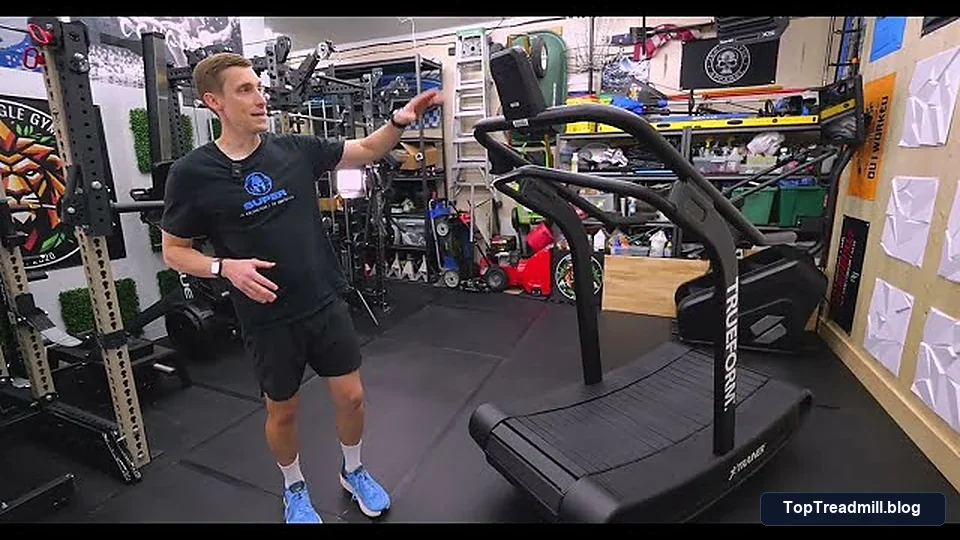
The wrap-around handrail offers multiple grip positions for high-intensity sled pushes and lateral drills. Its sturdy placement ensures absolute stability during maximal exertion sprinting intervals.
A minimalist digital console tracks basic metrics like distance, pace, and time. While lacking flashy entertainment apps, it provides essential data clearly without unnecessary distractions.
The consolidated console layout presents essential metrics via a high-contrast LCD screen positioned at an optimal viewing angle. Simple tactile buttons let athletes track speed, distance, wattage, and heart rate without navigating complicated digital menus.
Ergonomically angled handrails accommodate multiple grip positions for lateral shuffles and backward walking drills. The robust handlebar geometry remains completely rigid, providing reliable security when executing maximum effort sprints or heavy resistance pushes.
- Multi-position heavy-duty handrail design
- Simplified battery-powered performance console
- Clear real-time metric tracking display
Maintenance Protocols and Long-Term Durability
Eliminating motors and complex electronic boards drastically reduces routine upkeep requirements. Owners only need to clean the slat surface and check structural bolts periodically.
Featured in our best treadmill roundup, the individual rubber slats resist wear exceptionally well under heavy foot traffic. This mechanical simplicity translates directly into minimal downtime over years of heavy use.
Maintaining the curved slat-belt requires regular dust and debris removal from the internal bearing assemblies. Vacuuming the deck perimeter weekly prevents particulate accumulation that could prematurely wear out the precision guide rollers.
The individual elastomeric slats demand periodic inspection for surface wear and tear caused by cleated footwear. Applying recommended silicone lubricants to pivot points extends the mechanical lifespan of heavily stressed moving components indefinitely.
- Zero electrical motor maintenance needed
- Durable impact-resistant running slats
- Simple periodic fastener inspections
Setup, Assembly, and Spatial Footprint
Unboxing and assembling this heavy unit requires at least two people due to its substantial weight. Clear instructions guide you through securing the main uprights and console.
Transport wheels integrated into the base allow cautious repositioning across smooth gymnasium floors. Ensure you measure your doorway clearances before attempting to move the assembled machine.
Weighing over three hundred pounds, unpacking this machine necessitates at least two strong assembly technicians to prevent injury. The physical footprint measures roughly sixty-four inches long by thirty-two inches wide, requiring adequate surrounding clearance.
Integrated transport wheels and a rear grab handle allow straightforward repositioning across rubberized fitness flooring. Carefully leveling the heavy steel frame prevents rocking and ensures balanced mechanical load distribution across all four contact points.
- Substantial assembly weight requires assistance
- Integrated transport wheels for mobility
- Fixed upright structure profile
Final Buyer Assessment and Verdict
Serious runners and athletic facilities will find immense value in this specialized trainer. It transforms running technique while delivering an uncompromising cardiovascular training stimulus.
Casual walkers seeking leisurely strolls might prefer traditional motorized alternatives. However, dedicated athletes aiming to build raw power will appreciate every engineering choice here.
Facilities seeking a durable, self-powered running solution will find the TrueForm Trainer delivers exceptional commercial value. Its robust structural engineering withstands punishing daily workouts while actively improving user running mechanics and overall athletic performance.
While traditional runners may experience an initial learning curve, the uncompromised self-powered training benefits justify the investment. Athletes committed to developing superior sprinting form and cardiovascular endurance will maximize their functional training capabilities.
- Ideal for sports performance facilities
- Demands high physical effort from users
- Unmatched mechanical durability profile
Frequently Asked Questions
How does the non-motorized curved design affect my natural running form?
Operating this non-motorized curved deck forces runners to strike midfoot and drive forward powerfully through their hips rather than dangerously overstriding during intense sprints or distance sessions.
Because your own body provides absolute propulsion, this specialized running surface instantly corrects inefficient mechanics and builds superior athletic posture over long training blocks.
Is this manual treadmill suitable for casual walking and rehabilitation?
While you can certainly walk on it, the manual resistance requires significantly more initial physical effort to move the heavy belt than any standard motorized fitness machine on the market.
Therefore, rehabilitation patients or casual strollers might find the constant muscle engagement far too taxing for relaxed, low-intensity daily exercise routines.
What kind of ongoing maintenance does the mechanical slat system require?
Routine maintenance is remarkably straightforward because there is no electrical motor or complex circuit board to fail over many years of heavy gym usage.
Facility owners only need to periodically inspect the heavy structural steel bolts, clean the rubber running slats, and check overall belt alignment to ensure consistently smooth operational performance.
Can I use pre-programmed workouts or connect to fitness apps?
The included console is intentionally minimalist and focuses purely on essential performance metrics like speed, pace, distance, and time without offering built-in digital workout programming.
Users wanting interactive virtual classes must instead rely on external mobile devices or third-party tracking applications mounted securely nearby during intense daily training sessions.
How difficult is it to assemble and move this heavy-duty machine?
Initial product assembly requires at least two capable people due to the substantial weight of the commercial-grade steel frame and integrated structural components.
Once fully built, built-in transport wheels allow careful repositioning across flat flooring, though maneuvering the heavy unit through tight residential doorways remains exceptionally challenging for single users.