How to Calculate Treadmill Incline Percentage to Degrees? Math
Master the mathematical conversion between treadmill incline grades and geometric degrees. Accurate calculations ensure precise indoor simulation of outdoor terrain gradients.


Convert incline percentage to degrees using the arctan of grade divided by 100. Multiply the resulting radian value by 57.2958 to find your true geometric angle.
Ready to compare models? Start with our Best Treadmill: Top Home Cardio & Under-Desk Picks (2026).
Practical Quick-Reference Table
| Incline Percentage | Geometric Angle (Degrees) | Application Scenario |
|---|---|---|
| 1% | 0.57 degrees | Simulating flat outdoor headwind resistance |
| 3% | 1.72 degrees | Standard indoor road running simulation |
| 5% | 2.86 degrees | Moderate rolling hill training profile |
| 8% | 4.57 degrees | Steep hill climb endurance workout |
| 10% | 5.71 degrees | High-intensity mountain grade simulation |
| 15% | 8.53 degrees | Maximal incline power hiking protocol |
Mathematical Principles of Incline Conversion

Treadmill consoles display incline as a percentage rather than degrees. This metric represents the rise over run ratio, meaning a ten percent grade climbs ten units vertically for every one hundred units horizontally.
Converting this linear percentage into angular degrees requires basic trigonometry. You must calculate the inverse tangent function using data from our best home treadmill with incline guide as your input parameter.
- Incline percentage equals vertical rise divided by horizontal run multiplied by one hundred.
- Trigonometric inverse tangent calculates the exact geometric angle of the running deck.
- Radians must be converted to degrees by multiplying the output by fifty-seven point two nine.
- Console software applies internal algorithms to translate sensor signals into readable grade values.
Understanding the Tangent Ratio
The tangent of an angle in a right triangle compares the opposite side to the adjacent side. On a treadmill, the deck length serves as the hypotenuse, while vertical lift represents the opposite side.
Because deck length remains fixed during elevation, horizontal run decreases slightly as elevation increases. Engineers account for this geometric shift during console firmware calibration routines to maintain calculation accuracy.
- Hypotenuse length equals the stationary frame track or total belt length.
- Opposite leg height changes dynamically via the front elevation motor assembly.
- Adjacent horizontal distance shrinks marginally during maximum elevation adjustments.
Mechanics of Treadmill Elevation Systems
Modern motorized treadmills utilize a secondary elevation motor to adjust deck angle. This heavy actuator relies on a lead screw mechanism referenced inside our deck size calculator to raise the front structural crossmember.
Optical encoders or magnetic Hall effect sensors track motor rotation revolutions. The console controller interprets these electrical pulses to estimate current deck height and grade percentage during your workout session.
- Elevation motors require robust internal gearing to support heavy user weight loads safely.
- Lead screws translate rotational motor torque into smooth vertical lifting motion.
- Sensor feedback loops prevent the elevation frame from exceeding physical mechanical limits.
- Lubrication on lift screws prevents binding and ensures accurate positional tracking.
Actuator Calibration and Limits
Calibration routines reset the elevation tracking parameters upon initial power-up. The deck drops to zero percent before counting actuator revolutions upward to establish strict positional boundaries.
Mechanical limit switches provide a fail-safe backup against software calculation errors. If a sensor fails, these switches cut power to prevent catastrophic structural frame damage during adjustments.
- Zero calibration verifies absolute horizontal deck positioning before data logging.
- Limit switches protect internal drive components from over-extension stress.
- Firmware updates periodically optimize the pulse-to-grade calculation mapping tables.
Video Walkthrough: Right Triangle
Step-by-Step Trigonometric Calculations
Calculating your treadmill angle manually requires basic math tools. Start by checking options in our best incline treadmill to burn fat roundup and divide that numerical value by one hundred to create a decimal fraction.
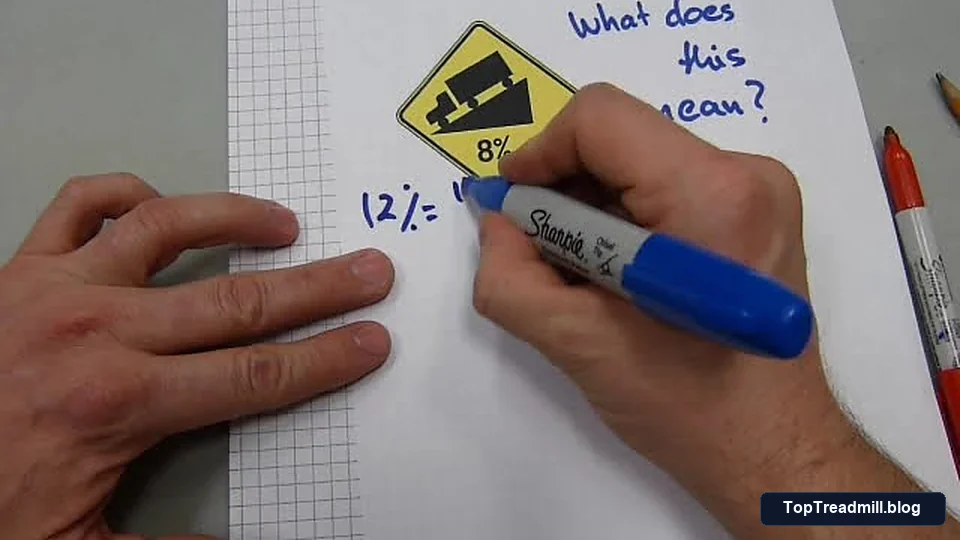
Next, apply the arctan function to your decimal fraction value. The calculator will output an angle measured in radians, which must then be multiplied by eighteen zero divided by pi to yield degrees.
- Step one: Divide treadmill grade by one hundred to establish your slope ratio.
- Step two: Input the resulting decimal into the inverse tangent function key.
- Step three: Multiply the radian result by fifty-seven point two nine five.
- Step four: Round your final degree measurement to two decimal places for precision.
Practical Mathematical Example
Consider a challenging twelve percent treadmill incline setting for your workout interval. Divide twelve by one hundred to get zero point one two as your working decimal fraction input.
Calculate the arctan of zero point one two to yield zero point one one nine radians. Multiply this figure by fifty-seven point two nine five to discover a true deck angle of six point eight four degrees.
- Input grade value: Twelve percent incline setting.
- Decimal conversion ratio: Zero point one two slope.
- Final computed angle: Six point eight four degrees geometric tilt.
Comparing Treadmill Grade to Road Gradient
Outdoor road cycling and running gradients use the exact same rise-over-run percentage formula. However, profiles explored in our best treadmill incline for fat loss review rarely match static indoor incline levels across a constant distance.
Wind resistance and surface compliance alter actual energetic output outdoors. Therefore, matching an outdoor hill climb requires adding minor incline percentages to compensate for missing environmental drag factors.
- Road gradients measure vertical rise per one hundred units of horizontal distance.
- Indoor treadmills eliminate aerodynamic drag, requiring subtle grade adjustments for equivalence.
- Outdoor terrain features undulating changes rather than uniform mechanical incline planes.
- Foot strike mechanics differ slightly between rigid road asphalt and cushioned treadmill belts.
Accounting for Indoor Biomechanics
Running on a motorized moving belt alters natural propulsive forces compared to stationary ground. A one percent treadmill incline is widely recommended to simulate flat outdoor wind resistance effectively.
Translating higher outdoor mountain grades indoors demands careful degree verification. Setting your machine to correct angular degrees ensures your training specificity remains aligned with target outdoor routes.
- One percent baseline incline mimics outdoor flat ground wind drag.
- Joint loading shifts perceptibly when transitioning from road to moving belt.
- Accurate degree conversion prevents overtraining specific muscle groups during simulations.
Calibration and Sensor Verification Methods
Over time, mechanical wear or floor unevenness can cause treadmill incline displays to drift. Verifying your console accuracy requires using a digital angle finder tool placed directly upon the running deck surface.
Always perform verification checks while the treadmill is safely powered off and unplugged. Place your digital inclinometer on the center running deck to compare physical degrees against console grade readings accurately.
- Digital angle finders provide reliable physical baseline measurements for deck tilt.
- Ensure your treadmill rests on a completely level floor surface before testing.
- Compare measured degrees against standard conversion tables to identify calculation discrepancies.
- Consult your user manual to execute a manual console recalibration sequence.
Using Digital Inclinometers Safely
Magnetic digital angle gauges attach securely to steel treadmill side rails for precise readings. Power on the gauge and zero the measurement on the floor before placing it on the raised deck.
Raise the treadmill to specific preset levels like five, ten, and fifteen percent. Record the physical degrees at each tier and verify them against mathematical conversion formulas to check sensor health.
- Zero the digital inclinometer on the floor before deck placement.
- Test multiple elevation increments across the full operational incline range.
- Document variances to determine if sensor recalibration is urgently required.
Video Walkthrough: Definition
Ergonomic and Biomechanical Implications
Changing your treadmill incline alters muscular recruitment patterns throughout your lower extremities. Steeper angles shift emphasis from hamstrings and calves toward your quadriceps and hip flexor muscle groups during strides.
Understanding exact degree measurements helps prevent acute overuse injuries during hill training. Excessive incline settings without adequate preparation can place unnecessary strain on your Achilles tendons and lower lumbar spine.
- Higher incline angles increase caloric expenditure and cardiovascular training intensity.
- Steep deck tilts demand greater ankle dorsiflexion flexibility from runners.
- Precise degree tracking allows for progressive, safe workload increases over time.
- Ergonomic posture should remain upright rather than leaning heavily on console handrails.
Joint Loading and Angle Limits
Knee joint shear forces change dynamically as incline degrees increase during workouts. Steeper angles reduce impact shock on knee joints while increasing load on posterior chain tissues significantly.
Limiting maximum continuous incline training helps maintain balanced musculoskeletal development. Cross-reference your target degree angles with physician-recommended rehabilitation parameters if recovering from lower body injuries.
- Incline walking minimizes high-impact ground reaction forces on joints.
- Posterior chain muscles absorb greater mechanical work at elevated degrees.
- Balanced training programs incorporate both flat and inclined intervals safely.
Troubleshooting Incline Motor Discrepancies
When your treadmill fails to reach calculated incline angles, mechanical binding or motor failure is likely. Inspect the front elevation assembly and lift arms for any physical obstructions or debris buildup.
Electrical communication errors between the console and motor control board can also skew readings. Resetting the console power cycle often clears temporary firmware glitches affecting position sensors and elevation commands.
- Inspect lift motor wiring harnesses securely connected to the control board.
- Clear dust and pet hair from lead screws to prevent mechanical jamming.
- Test console voltage output terminals using a reliable multimeter if necessary.
- Contact certified technicians if internal motor actuators fail calibration protocols.
Resolving Calibration Error Codes
Console error codes often indicate a failed calibration sequence during startup. Enter the technician diagnostic menu to clear stored elevation fault logs and restart the zeroing procedure.
Ensure the treadmill safety key is firmly engaged before attempting any diagnostics. Proper system voltage is critical for actuators to complete full range calibration without stalling.
- Access hidden diagnostic menus using manufacturer-specific button sequences.
- Clear old error logs before initiating a fresh calibration test.
- Verify wall outlet power delivery to prevent low voltage actuator stalls.
Frequently Asked Questions
How do I convert treadmill incline percentage to degrees?
Calculate the arctan of your incline percentage divided by one hundred. Multiply that radian result by 57.2958 to find your true geometric angle.
Why do treadmills use percentages instead of degrees?
Percentages represent the rise-over-run ratio, which is standard in civil engineering and road grading. This metric makes it easier to compare indoor workouts to outdoor terrain.
What degree angle equals a 10 percent treadmill incline?
A ten percent treadmill incline equals approximately 5.71 geometric degrees. This calculation uses the inverse tangent formula divided by standard radian conversion factors.
Does running on an incline change my calorie burn?
Yes, increasing your incline angle raises your overall metabolic demand and cardiovascular workload. Higher degrees shift mechanical emphasis toward your quadriceps and gluteal muscles significantly.
How can I verify my treadmill incline is accurate?
Place a digital angle finder or magnetic inclinometer on the running deck. Compare the measured physical degrees against your console grade settings to check calibration.