Walkingpad K12 vs R1 Pro: Concise Verdict
Comparing two compact fitness machines reveals distinct engineering priorities. Choose between dedicated walking stability and versatile running performance for your home workspace.

Pick the Walkingpad K12 for ultra-low-profile under-desk walking sessions. Choose the R1 Pro if you require a folding handrail and dual-mode running speeds.
Compare all top models in our Best Treadmill: Top Home Fitness Picks (2026 Guide).
Side-by-Side Breakdown
| Criteria | Walkingpad K12 | R1 Pro | Edge |
|---|---|---|---|
| Core Design / Build | Low-profile welded steel frame optimized strictly for walking use. | Innovative 180-degree folding frame featuring an integrated handrail. | R1 Pro |
| Real-World Performance | Supports speeds up to 5 mph with smooth motor response. | Reaches 7.5 mph allowing for light jogging sessions. | R1 Pro |
| Ease of Setup & Use | Arrives fully assembled for instant unbox-and-walk deployment. | Requires unfolding the handlebar assembly before operating. | Walkingpad K12 |
| Durability & Reliability | Solid deck construction rated for standard daily office use. | Complex folding hinge requires periodic maintenance checks. | Walkingpad K12 |
| Efficiency / Operating Footprint | Extremely flat profile easily slides beneath low-clearance furniture. | Slightly taller folded profile requires vertical storage space. | Walkingpad K12 |
| Maintenance Requirements | Standard belt lubrication and occasional tension adjustments. | Hinges and handrail locking pins add maintenance checkpoints. | Walkingpad K12 |
| Best Ideal Use Case | Dedicated standing desk workers seeking silent background steps. | Users wanting a convertible walking and light running pad. | Split |
Core Design and Engineering Differences
Evaluating the structural integrity of these units reveals unique engineering approaches. The Walkingpad K12 focuses on an ultra-slim profile for seamless integration beneath office furniture and standard standing desks.
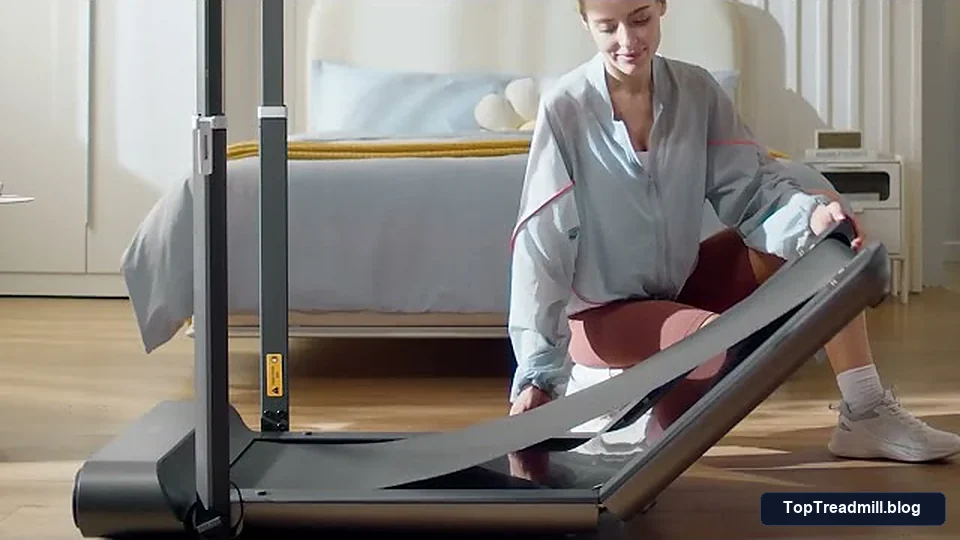
Conversely, the R1 Pro utilizes a patented dual-fold mechanism. This allows the deck and upright handles to collapse compactly, changing the entire physical footprint of the exercise equipment.
Examining the frame construction, the K12 features a rigid single-piece chassis designed specifically for flat walking, while the Kingsmith Walkingpad R2 Pro review details how its specialized folding hinge accommodates dual-mode jogging.
Motor placement also differs significantly between these two models. The K12 houses a streamlined brushless motor under the front cowl, whereas the R1 Pro integrates a slightly larger drive motor housing to support higher speeds.
- Chassis height: K12 features a lower step-on height for easier mounting.
- Frame geometry: R1 Pro incorporates structural uprights for balance support.
- Weight distribution: K12 spreads mass evenly across a rigid single platform.
Frame Materials and Structural Rigidity
Manufacturer choices in alloy selection dictate overall longevity. Both models leverage industrial-grade aluminum alloys to minimize weight while maintaining high tensile strength under repetitive foot strikes.
Rigidity directly impacts perceived noise levels during operation. Solid frame construction prevents unwanted vibration transfer into residential subfloors during intense walking intervals.
- Aluminum alloy construction reduces overall unit weight significantly.
- Reinforced stress points prevent frame flexing under maximum load.
Real-World Performance Comparison
Motor output dictates how each machine handles user weight and speed demands. Unlike alternatives explored in our Kingsmith Walkingpad R2 Pro Plus technical review, the K12 is calibrated specifically for low-impact walking routines.
The R1 Pro expands its operational envelope by accommodating jogging speeds. This dual capability makes it a versatile option for users transitioning between casual steps and faster aerobic pacing.
During actual usage, the K12 delivers reliable speed regulation up to six miles per hour, making it ideal for under-desk productivity. Its belt transitions smoothly without abrupt jerks during pace adjustments.
Conversely, the R1 Pro reaches higher operational thresholds up to seven miles per hour when the safety handrail is fully locked upward. This expansion accommodates light jogging routines for active users.
- Top speed limits: K12 peaks at a moderate walking velocity.
- Acceleration curves: R1 Pro offers manual and automatic speed adjustments.
- Torque delivery: Both brushless motors maintain smooth rotation under load.
Motor Torque and Speed Consistency
Brushless motor technology ensures continuous torque delivery without excessive heat buildup. Users notice minimal belt hesitation when stepping down firmly on the front roller zone.
Maintained speed consistency prevents awkward gait adjustments during long work sessions. Smooth acceleration curves protect sensitive knee joints from sudden velocity jolts.
- Brushless motor designs reduce operational heat and electrical noise.
- Consistent belt tracking prevents slipping during heavy stride impacts.
Folding Mechanism and Storage Profiles
Storage convenience remains a primary selling point for compact walking pads. The Walkingpad K12 relies on horizontal storage, sliding effortlessly under sofas or elevated bed frames.
The R1 Pro introduces vertical storage capabilities via integrated transport wheels. This upright storage mode lets the machine stand securely against a wall without tipping over.
Storage efficiency sets these units apart through distinct folding mechanics. The R1 Pro features a patented 180-degree fold that drastically reduces its footprint, allowing vertical placement against standard living room walls.
Meanwhile, the K12 relies on a non-folding deck profile that prioritizes structural rigidity over compact stowing. Transport wheels are fitted to both models to ease horizontal movement under furniture pieces.
- Storage orientation: K12 excels at flat under-furniture storage.
- Transport wheels: R1 Pro features smooth-rolling casters for easy repositioning.
- Locking latches: R1 Pro includes safety locks to secure the folded frame.
Footprint Management in Tight Spaces
Apartment dwellers must carefully evaluate spatial constraints before purchasing fitness gear. As highlighted in our roundup of the best walkingpad models, the flat design of the K12 eliminates vertical clearance issues inside home offices.
Meanwhile, the R1 Pro demands vertical wall clearance when folded upright. Users must ensure overhead lamps or shelving units do not obstruct the vertical storage path.
- Horizontal slide clearance requires minimal vertical room heights.
- Vertical storage footprints save valuable floor space in small rooms.
Control Interfaces and Smart Integration
Digital interfaces dictate how easily users modify settings mid-workout. The Walkingpad K12 relies primarily on a minimalist LED display embedded beneath the running belt surface.
The R1 Pro features a dedicated console display mounted on the folding handrail. This provides clearer visibility for speed, distance, and elapsed workout time metrics.
Controlling each machine involves different paradigms. The K12 relies primarily on a handheld remote and an embedded LED display panel, whereas the R1 Pro incorporates an integrated LED dash on the folding handlebar.
Both treadmills connect smoothly with proprietary mobile applications via Bluetooth telemetry to track workout metrics. Automatic speed control modes use footstep sensors to modulate belt velocity without manual button presses.
- Display placement: K12 uses deck-embedded LEDs; R1 Pro uses handrail screens.
- App connectivity: Both models sync with companion mobile applications.
- Remote controls: Handheld remotes offer convenient speed adjustments.
Adaptive Speed Control Technology
Footstep sensors track user positioning to modulate belt speed automatically. Moving toward the front roller accelerates the belt, while drifting backward slows the machine down.
This adaptive mode removes the need for constant manual remote adjustments. Users can focus entirely on work tasks or media consumption without distraction.
- Pressure sensors detect user zone positioning on the belt.
- Automatic speed modulation offers a truly hands-free experience.
Maintenance, Efficiency and Longevity
Long-term ownership costs depend heavily on routine maintenance requirements. The Walkingpad K12 features a simplified deck design that minimizes mechanical failure points over years of use.
The R1 Pro demands slightly more attention due to its folding hinge components. Regular inspection of pivot bolts ensures structural safety during high-frequency folding cycles.
Routine upkeep requires regular silicone belt lubrication to minimize friction between the running deck and walking belt. The K12 features an accessible lubrication port that simplifies this essential monthly maintenance task.
Electrical efficiency remains high across both devices, drawing minimal current during standard walking sessions. Keeping the running surface clean from dust accumulation prevents premature motor strain and ensures long-term operational durability.
- Belt lubrication: Both units require periodic silicone oil application.
- Tension alignment: Roller bolts need occasional tuning to prevent drifting.
- Hinges: R1 Pro folding joints require scheduled fastener checks.
Preventative Care for Continuous Operation
Applying proper silicone lubricant preserves walking belt integrity. Users should follow manufacturer guidelines regarding interval timing to prevent premature deck friction wear.
Keeping the running surface clean from dust protects internal electronics. Regular vacuuming around the motor housing prevents overheating during extended walking sessions.
- Silicone lubricant application prevents excessive friction and motor strain.
- Dust prevention safeguards internal circuit boards from premature failure.
Ergonomics and Biomechanical Considerations
Walking pad ergonomics directly influence user comfort and joint health. The Walkingpad K12 provides a low-impact deck cushioning system designed to absorb shock effectively.
The R1 Pro adds a physical handrail option that enhances stability. This handrail proves essential for users requiring extra balance support during faster walking speeds.
Step-up height is a critical ergonomic factor for home fitness equipment. Both models maintain a low deck profile that reduces joint impact forces compared to traditional bulky health club treadmills.
Belt width also affects user comfort during extended walking sessions. Selecting a machine with adequate lateral clearance prevents missteps while maintaining a natural, unrestricted stride length throughout your daily exercise routine.
- Deck cushioning: Multi-layer belts reduce impact forces on joints.
- Handrail utility: R1 Pro provides an anchor point for secure pacing.
- Stride clearance: Both units accommodate natural walking biomechanics.
Impact Absorption and Joint Protection
Multi-layer running belts distribute foot strike pressure across the platform. This engineered cushioning mitigates stress on ankles, knees, and lower lumbar regions during exercise.
Users exercising for hours daily benefit significantly from shock absorption. Reduced vibration transfer prevents chronic joint fatigue associated with hard flooring surfaces.
- Engineered cushioning layers absorb high-frequency impact vibrations.
- Ergonomic deck construction protects joints during extended daily sessions.
Which Option Fits Your Setup
Selecting the right treadmill depends on your specific lifestyle needs. The Walkingpad K12 is the superior choice for dedicated remote workers seeking an invisible under-desk walking solution.
The R1 Pro suits users who value versatility above all else. Its folding handrail and higher top speed deliver a traditional experience, much like the units analyzed in our Proform Pro 9000 treadmill review.
Choosing between these devices depends heavily on your available floor space and fitness goals. Opt for the K12 if your primary objective is permanent under-desk integration without frequent folding requirements.
Alternatively, select the R1 Pro if you require a versatile machine that transitions seamlessly from a tucked-away storage corner to an active light jogging setup whenever your daily schedule permits.
- Choose K12 for low-profile under-desk office integration.
- Choose R1 Pro for convertible walking and light jogging flexibility.
- Evaluate available storage space before making your final purchase.
Final Decision Matrix for Buyers
Assess your daily movement goals and available room dimensions carefully. Prioritizing strict under-desk stealth points directly toward the K12 model configuration.
Conversely, wanting a convertible machine with safety rails highlights the R1 Pro. Matching equipment specs to personal habits guarantees long-term fitness satisfaction.
- Match machine top speeds to your personal fitness objectives.
- Measure your storage clearance spaces accurately prior to ordering.
Frequently Asked Questions
Can I slide the Walkingpad K12 completely under a low-profile sofa?
Yes, the ultra-slim design of the Walkingpad K12 allows it to fit beneath most standard low-clearance furniture items easily. This flat horizontal profile maximizes space efficiency in cramped home environments.
Does the R1 Pro require me to use the folding handrail while walking?
No, you can operate the R1 Pro with the handrail folded flat for under-desk use. Raising the handrail simply unlocks higher jogging speeds and provides extra balance security.
How often should I lubricate the running belts on these walking pads?
You should apply specialized silicone lubricant every few months depending on usage frequency. Regular maintenance prevents excessive friction and extends the lifespan of the motor system.
Are these walking pads noisy during office conference calls?
Both models utilize quiet brushless motors that produce minimal operational noise during standard walking speeds. Background sound remains low enough to stay completely unnoticeable during standard virtual meetings.
What is the primary difference in top speed between these two models?
The Walkingpad K12 is engineered exclusively for standard walking velocities, while the R1 Pro supports faster jogging speeds up to 7.5 mph for versatile workouts.