Treadmill Speed vs Outdoor Speed: Mechanical Truth
Comparing indoor motorized belts against outdoor ground physics reveals critical differences in pacing, biomechanics, and energy output. Understanding these mechanical variations helps runners optimize their training sessions safely.

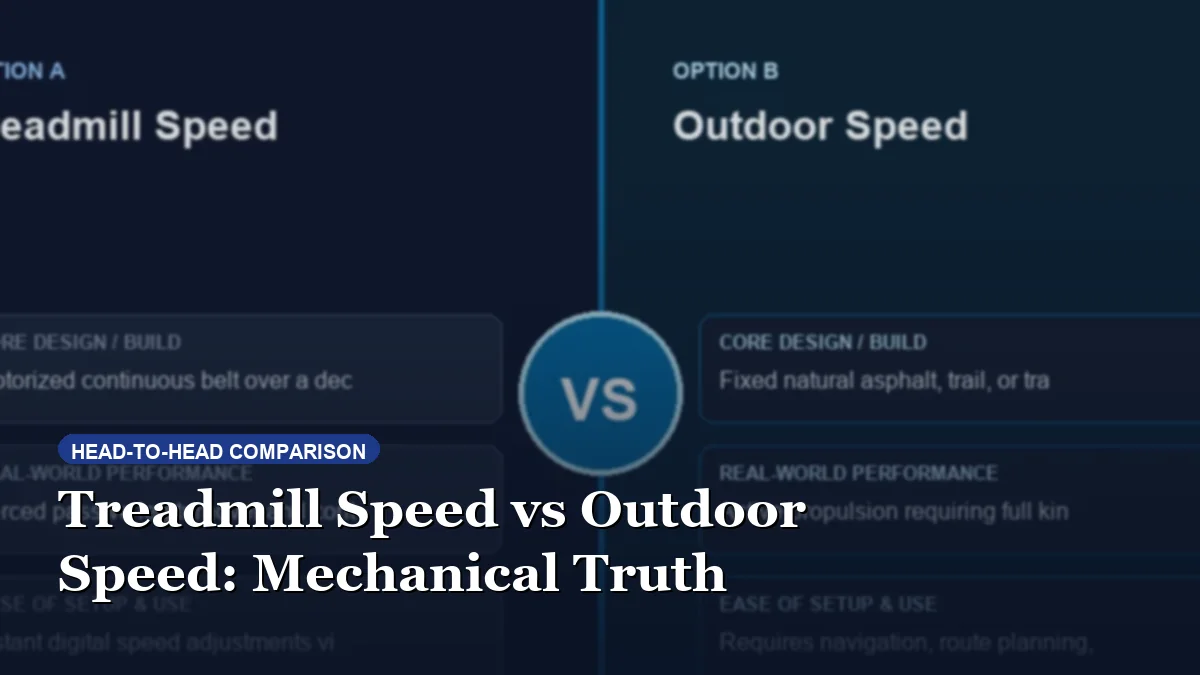
Choose Treadmill Speed for precise interval calibration and controlled environments, but rely on Outdoor Speed for authentic race preparation and natural terrain resistance adaptations.
Compare all top models in our Best Treadmill: Top Home Fitness Picks (2026 Guide).
Side-by-Side Breakdown
| Criteria | Treadmill Speed | Outdoor Speed | Edge |
|---|---|---|---|
| Core Design / Build | Motorized continuous belt over a deck | Fixed natural asphalt, trail, or track surfaces | Outdoor Speed |
| Real-World Performance | Forced passive leg turnover and controlled pacing | Active propulsion requiring full kinetic drive | Outdoor Speed |
| Ease of Setup & Use | Instant digital speed adjustments via console | Requires navigation, route planning, and weather checks | Treadmill Speed |
| Durability & Reliability | Dependent on motor horsepower and belt lubrication | Weather-resistant natural terrain requiring no mechanical upkeep | Outdoor Speed |
| Efficiency / Operating Footprint | Consumes electrical power and indoor floor space | Zero electrical draw with unlimited open pathways | Outdoor Speed |
| Maintenance Requirements | Regular deck waxing, belt tensioning, and dust clearing | Zero direct maintenance outside proper footwear selection | Outdoor Speed |
| Best Ideal Use Case | Controlled speed work and rehabilitation training | Long-distance endurance and race day simulation | Outdoor Speed |
Core Design and Engineering Mechanics
Indoor running relies on a continuous motorized belt driven by a heavy-duty continuous horsepower motor. This system pulls the running surface backward beneath your feet at a constant, unyielding mechanical rate.

Conversely, outdoor running requires your own muscular system to generate every ounce of forward propulsion. Your hamstrings and glutes must actively push against the stationary earth to create forward momentum instantly.
Mechanical engineering on modern machines incorporates elastomer cushioning systems to absorb impact shocks. Natural terrain lacks these shock-absorbing decks, forcing your joints to absorb the full reaction force of each strike.
Indoor motorized decks rely on continuous-duty drive motors to propel a moving running belt beneath your feet. This mechanical assistance fundamentally alters your natural gait cycle compared to pushing off solid asphalt.
Engineers calibrate rollers and deck thickness to minimize friction coefficients while supporting high-impact running strides. Heavy-duty frames absorb lateral forces to prevent structural flexing during intense sprint intervals and long-distance endurance training blocks.
The interaction between your footwear rubber compound and the phenolic-waxed deck surface determines immediate traction. Unlike gritty concrete, synthetic treadmill belts offer uniform slip resistance across every single square inch of the active running zone.
- Motorized belts force consistent leg turnover without natural pacing shifts.
- Outdoor paths demand active kinetic propulsion driven by hamstring engagement.
- Indoor decks feature elastomer cushioning that alters structural impact loads.
Motorized Drive vs Static Ground
The fundamental difference lies in how your foot interacts with the surface below you. A treadmill belt moves backward, meaning you simply lift and reposition your legs rhythmically.
Outside, your body moves forward across a completely stationary ground plane, engaging different stabilizer muscles and core groups to maintain balance and forward vector control during running strides.
- Treadmill belts reduce the need for active toe-off propulsion.
- Stationary ground demands full muscular engagement through every stride phase.
Belt Kinematics Versus Terrain Resistance
Running on a moving belt changes your natural biomechanics because the machine assists your leg swing. This passive assistance makes treadmill running feel mechanically easier at identical belt speeds.
Outdoor runners must overcome rolling resistance, uneven pavement cracks, and subtle elevation changes. These microscopic surface imperfections increase the overall metabolic cost of running outdoors significantly.
To compensate for the lack of wind and belt assistance, many coaches recommend setting a minimal incline. Adding a slight grade bridges the mechanical gap between indoor belts and outdoor paths.
When running outside, your muscles must actively overcome variable ground reaction forces and minor surface irregularities. Treadmill belts eliminate this propulsion requirement because the motor actively moves the running surface backward beneath your center of mass.
To compensate for lacking environmental resistance, many conditioning experts recommend applying the best treadmill incline to simulate outdoor running. This minor upward tilt effectively mimics natural aerodynamic drag during sessions.
Belt speed consistency relies heavily on pulse width modulation controllers that regulate current delivery to the drive system. High-end units prevent micro-stalls when your foot strikes the running belt at high velocities.
- Passive belt assistance reduces the physical effort of leg extension.
- Outdoor surfaces introduce rolling resistance and micro-elevation shifts.
- A one-percent incline successfully mimics outdoor aerodynamic drag metrics.
Understanding Surface Interaction
When your foot strikes a motorized belt, the material compresses under your weight and springs back. This dynamic interaction alters your natural stride length compared to rigid concrete.
Outdoor concrete and asphalt provide zero give, resulting in higher shock loads transmitted directly up through your ankles, knees, and lower back during high-speed training efforts.
- Belt compression alters natural ankle dorsiflexion angles.
- Rigid outdoor pavement maximizes impact shock transmission.
Aerodynamic Drag and Energy Expenditure
Indoor runners experience zero relative wind resistance unless utilizing an overhead cooling fan. This absence of aerodynamic drag lowers the actual metabolic energy required to maintain high speeds.
Outdoor runners plow through ambient air, creating significant aerodynamic drag that escalates exponentially with velocity. At higher velocities, fighting headwind consumes a substantial portion of your total energy output.
Physiological studies show that running indoors feels easier because your body cools less efficiently. Without moving air cooling your skin, heart rate climbs higher despite lower aerodynamic effort levels.
Outdoor runners constantly push through ambient air, generating significant wind resistance. When comparing indoor setups with our best outdoor treadmill guide, stationary machines lack this natural airflow, resulting in lower metabolic energy expenditure.
Utilizing a high-velocity personal cooling fan or training in an open room helps simulate outdoor thermal stress. However, core cardiorespiratory metrics like oxygen consumption still tend to favor outdoor conditions due to thermal regulation demands.
Calculating true energetic equivalence requires factoring in the lack of headwind resistance on standard indoor motorized trainers. Adjusting console speeds upward by roughly three percent bridges this physiological gap for serious endurance athletes.
- Aerodynamic drag is completely absent in enclosed indoor spaces.
- Outdoor movement requires overcoming air resistance at every step.
- Indoor thermal buildup often artificially elevates your heart rate metrics.
The Wind Factor in Speed
Moving through still air outside requires constant muscular effort to push air molecules aside. This invisible barrier explains why matching your outdoor pace indoors feels noticeably less exhausting.
Deploying high-velocity external fans during treadmill workouts helps simulate cooling breezes, but it cannot replicate the true physical drag encountered on open outdoor running routes.
- Ambient air creates a physical barrier requiring extra muscular output.
- External fans cool the skin but fail to provide true aerodynamic resistance.
Biomechanical Impact and Stride Adaptation
Treadmill users often adopt a shorter, quicker stride because the moving belt truncates the back end of their leg extension. Overstriding becomes dangerous on treadmills if your foot catches the motor housing.
Outdoor runners enjoy complete freedom of movement, allowing natural stride lengths and variable cadences. You can surge, brake, and corner freely without worrying about physical equipment boundaries.
Joint loading profiles differ dramatically between these two training environments due to surface rigidity. Alternating between both modalities protects your musculoskeletal system from repetitive stress injuries.
The cushioned deck of a quality treadmill absorbs considerable shock, reducing cumulative stress on your joint structures and connective tissues. Concrete pavements force lower limbs to handle much harsher, unyielding impact forces with every stride.
Many runners unconsciously shorten their stride length on motorized units due to fear of misstepping near the plastic motor hood. This behavioral adjustment alters normal cadence and running efficiency over extended training distances.
Maintaining optimal running posture becomes vital when transitioning between motorized surfaces and outdoor tracks. Core engagement prevents slouching, which naturally occurs when individuals rely too heavily on the steady rhythm of a moving belt.
- Shorter strides are common due to the moving belt surface.
- Outdoor settings allow unrestricted movement and variable foot placement.
- Mixed modality training prevents repetitive stress injuries effectively.
Stride Length Discrepancies
Because the belt pulls your foot backward, you do not need to pull through the ground as forcefully. This mechanical aid slightly alters your natural running economy over time.
Outdoor tracks and roads demand total neuromuscular control, ensuring your glutes and hamstrings remain fully active throughout the entire propulsive phase of your running stride.
- Belt pull minimizes posterior chain engagement during push-off.
- Road running forces complete neuromuscular activation through the stride cycle.
Motorized Calibration vs Natural Momentum
A digital treadmill motor maintains an exact speed regardless of fatigue. When evaluating the best speed for weight loss on treadmill routines, users must match the console pace precisely.
Outdoor speed fluctuates naturally based on your current energy reserves, mental focus, and terrain profile. These subtle pace variations build superior pacing intuition for race day events.
Calibration accuracy varies across different machine models, requiring periodic belt speed verification. Outdoor distances measured via GPS or physical track markings always reflect absolute true ground speed.
Factory speed settings depend on precise optical encoder sensors that monitor roller rotation frequency to ensure exact belt velocity. Over time, worn drive belts can cause actual speeds to drift away from console displays.
Outdoor running relies entirely on your body generating forward momentum through muscular propulsion and gravitational pull. Treadmills remove this initial push phase, making high-speed interval training feel mechanically distinct from outdoor track sprints.
Regular tachometer checks and belt tension adjustments ensure that your treadmill accurately matches your desired training pace. Neglecting these maintenance tasks compromises workout data accuracy and alters your long-term running biomechanics.
- Digital motors enforce strict, unyielding speed parameters without mercy.
- Outdoor running fosters natural pacing intuition and internal rhythm.
- GPS tracking ensures true ground speed measurement without calibration drift.
Pacing Discipline Indoors
Training on a motorized belt forces strict adherence to target splits without deviation. This rigidity proves invaluable for marathon training blocks requiring precise threshold pace intervals.
Relying entirely on machine pacing can hinder your ability to gauge effort by feel alone, making outdoor races challenging if your internal pacing clock remains underdeveloped.
- Motorized control eliminates unintentional slowing during hard intervals.
- Over-reliance on digital prompts can weaken natural effort perception.
Maintenance, Efficiency, and Wear Factors
Treadmills require diligent upkeep, including regular belt lubrication, running deck inspections, and dust removal. Neglecting these maintenance tasks ruins the motor controller and burns out expensive drive belts.
Outdoor running requires zero mechanical maintenance beyond purchasing supportive running shoes and selecting safe routes. The operating footprint is limitless, costing nothing in household electricity consumption.
Electrical efficiency matters when running high-speed intervals indoors for extended periods. Modern AC and DC motors draw substantial wattage from your wall outlet during peak load demands.
Proper lubrication prevents excessive heat buildup between the running belt and the low-friction deck. Routine silicone applications reduce electrical amp draw and extend the operational lifespan of both the motor and electronic controllers.
Outdoor running paths present unpredictable hazards like potholes and debris, whereas indoor machines require monitoring electrical current fluctuations. Keeping internal components dust-free ensures reliable speed regulation during intense daily usage cycles.
Inspecting drive belt alignment prevents premature edge fraying and maintains smooth power transmission from the motor flywheel. Establishing a monthly maintenance routine protects your investment and ensures consistent running speed calibration.
- Belt lubrication and deck cleaning prevent premature motor burnout.
- Outdoor training requires zero mechanical maintenance or power consumption.
- High-speed indoor intervals draw significant electrical wattage from outlets.
Long-Term Equipment Longevity
Heavy running speeds generate intense friction between the walking belt and deck plate. High-quality silicone lubricants are mandatory to keep operating temperatures manageable during intense workouts.
Outdoor tracks suffer natural weather wear, but runners face no equipment replacement costs when surfaces degrade. Conversely, mechanical units require careful maintenance, prompting users to consult our best treadmill for outdoor use guide.
- Friction management dictates the lifespan of indoor running belts.
- Outdoor routes eliminate expensive equipment repair and parts replacement.
Environmental Control and Physiological Output
Indoor training environments isolate you from extreme weather, dangerous traffic, and uneven footing hazards. This controlled climate lets you execute exact speed workouts safely year-round.
Outdoor conditions introduce variables like humidity, high temperatures, rain, and cold winds. While challenging, adapting to these elements prepares your cardiovascular system for unpredictable race day weather.
Monitoring sweat rates and core temperature indoors prevents dangerous overheating. Proper indoor ventilation remains critical when pushing maximum speeds without natural wind cooling.
Indoor running eliminates weather variables like rain, ice, and extreme heat, allowing for precise heart rate monitoring and pace control. Ambient climate stability helps athletes execute structured training regimens without environmental interference.
Without natural convective cooling from outdoor breezes, indoor core body temperature rises faster, impacting perceived exertion levels. Proper facility ventilation is essential to match outdoor physiological output during long treadmill sessions.
Thermoregulation stress on a treadmill can elevate sweat rates significantly compared to identical outdoor speeds in cooler atmospheric conditions. Monitoring hydration status prevents premature fatigue during extended indoor endurance training blocks.
- Climate control protects runners from hazardous weather and traffic.
- Outdoor elements build heat acclimatization and mental resilience.
- Proper indoor ventilation is essential during high-speed sessions.
Safety and Environmental Adaptability
Controlling your workout environment ensures consistent training consistency regardless of external storms. You can push maximum velocity without scanning for potholes or oncoming vehicles.
Outdoor runners must remain vigilant regarding visibility, footing obstacles, and vehicle traffic. However, this outdoor exposure builds robust mental toughness and real-world situational awareness.
- Indoor rooms eliminate trip hazards and vehicle collision risks.
- Outdoor routes cultivate mental toughness and situational awareness.
Frequently Asked Questions
Is treadmill speed the same as running outside?
No, because motorized belts assist your leg turnover while indoor air lacks natural aerodynamic drag. You must add a slight incline to replicate true outdoor effort.
Why does treadmill running feel harder on my lungs?
Indoor spaces often lack adequate air circulation, causing heat buildup and elevated heart rates. Proper ventilation makes indoor pacing feel much more comfortable.
Should I adjust the incline to match outdoor speed?
Yes, setting a one-percent incline compensates for the absence of wind resistance. This small adjustment bridges the mechanical gap between both training modalities.
Do treadmills ruin your natural running stride?
They can cause shorter strides if the moving belt truncates your natural leg extension. Alternating between indoor and outdoor runs preserves optimal running biomechanics.
Which option is better for speed interval workouts?
Treadmills excel at precise speed control and consistent split times. Outdoor tracks are also great for natural pacing development.