Smart Treadmill vs Basic Treadmill: Technical Guide
Choosing between interactive connected fitness and straightforward mechanical reliability changes your daily home running experience. We break down the engineering and performance metrics.

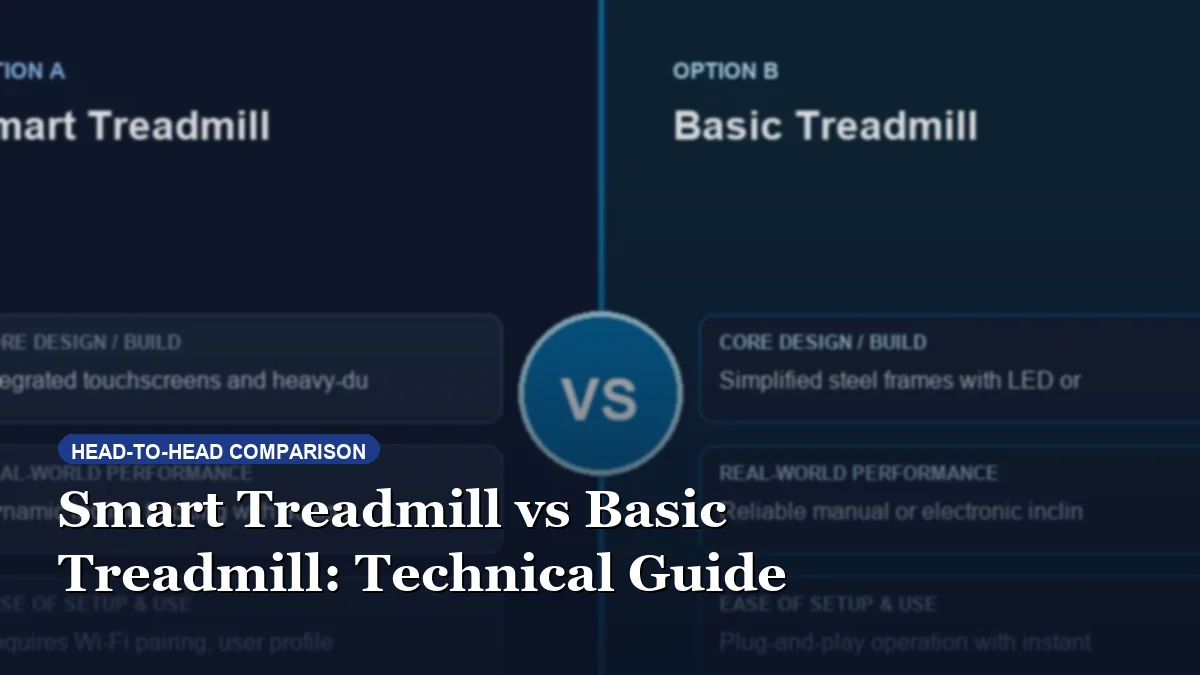
Choose a smart treadmill if you crave immersive coached programming and auto-adjusting resistance. Opt for a basic treadmill if you prioritize mechanical simplicity, zero subscription fees, and long-term hardware durability.
Compare all top models in our Best Treadmill: Top Home Fitness Picks (2026 Guide).
Side-by-Side Breakdown
| Criteria | Smart Treadmill | Basic Treadmill | Edge |
|---|---|---|---|
| Core Design / Build | Integrated touchscreens and heavy-duty reinforced frames. | Simplified steel frames with LED or LCD consoles. | Basic Treadmill |
| Real-World Performance | Dynamic incline tracking with automated resistance sync. | Reliable manual or electronic incline adjustments. | Smart Treadmill |
| Ease of Setup & Use | Requires Wi-Fi pairing, user profiles, and software updates. | Plug-and-play operation with instant manual controls. | Basic Treadmill |
| Durability & Reliability | Complex electronics create more potential failure points. | Fewer electrical components mean fewer repairs over time. | Basic Treadmill |
| Efficiency / Operating Footprint | Higher standby power draw due to large displays and receivers. | Minimal parasitic electrical load when idle. | Basic Treadmill |
| Maintenance Requirements | Requires software patches alongside standard belt lubrication. | Standard mechanical upkeep like belt tensioning and lubrication. | Basic Treadmill |
| Best Ideal Use Case | Virtual runners wanting trainer-led studio classes at home. | Dedicated runners tracking independent splits and intervals. | Basic Treadmill |
Core Design and Engineering Differences
Engineering a connected fitness machine requires a heavy chassis to support massive HD consoles. Manufacturers integrate complex motherboards, streaming processors, and robust wireless antennas right into the primary upright structures of the unit.
Conversely, traditional running machines prioritize mechanical integrity over digital interfaces. Their designs focus on heavy-gauge steel welding, commercial-grade drive motors, and impact-absorbing decks without extra thermal loads from high-end graphics processors.
- Connected units feature large touchscreens requiring dedicated cooling fans.
- Traditional models use membrane keypads resistant to sweat and dust.
- Frame weight differs significantly due to internal computer housing.
- Wiring harnesses are vastly more complex inside interactive fitness units.
Console Architecture and Display Technology
Smart consoles utilize tablet-grade processors to render real-time virtual terrain graphics and streaming video feeds. This hardware demands active cooling systems and robust power supplies to prevent thermal throttling during long workouts.
Traditional consoles rely on simple LED or LCD matrix screens designed to display essential metrics. Many models featured in our best basic treadmill for home use roundup consume minimal energy while resisting perspiration.
- Interactive screens run customized Android or Linux operating systems.
- Basic displays show speed, time, distance, and calories clearly.
Frame Rigidity and Structural Engineering
Structural engineers must reinforce the console mast on connected models to prevent screen vibration during high-speed running. Extra gussets and thicker steel tubing absorb the heavy loads generated by large pivoting display arms.
Standard machines direct structural engineering efforts entirely toward the running deck and motor mount. Eliminating heavy screens allows manufacturers to invest saved capital into superior frame gussets and thicker deck boards.
- Upright stability is a primary engineering challenge for smart displays.
- Traditional frames offer exceptional longevity under heavy daily foot traffic.
Real-World Performance and Training Dynamics
Performance metrics on interactive units featured within our best smart folding treadmill with zwift review rely heavily on automated software. This hardware communicates seamlessly with external servers to adjust belt speed dynamically.
Traditional running platforms offer immediate tactile feedback via quick-touch buttons or physical paddles. Users maintain total control over their pacing strategy without waiting for external cloud commands or internet bandwidth synchronization.
- Automated incline changes match virtual topography seamlessly.
- Manual speed adjustments offer instant tactile response without lag.
- Heart rate integration varies widely between open and closed ecosystems.
- Interval training relies heavily on quick motor response times.
Incline and Decline Responsiveness
Motorized elevation systems on connected units use linear actuators to simulate steep mountain climbs and descents. These actuators must process rapid commands from streaming software to synchronize with visual cues.
Basic models utilize simpler elevation motors that respond instantly to manual button presses. While they rarely offer decline features, their upward incline ranges provide reliable physiological resistance for traditional workouts.
- Decline capability is almost exclusively found on high-end connected units.
- Elevation actuators require periodic calibration to maintain accuracy.
Pace Regulation and Motor Torque
Continuous horsepower ratings dictate how well a motor maintains speed under heavy footstrikes. Connected platforms often feature robust drive systems to handle the fluctuating demands of automated interval programming and heavy runners.
Traditional units focus on continuous torque delivery, ensuring zero hesitation when runners push off the belt. This reliable mechanical output supports steady-state endurance training and strict pace maintenance over long sessions.
- High continuous torque prevents micro-stalls during heavy heel strikes.
- PWM controllers regulate electrical current sent to the drive motor.
Electronics, Connectivity, and Software
Software ecosystems define the modern connected running experience, requiring constant Wi-Fi connectivity and active subscription models. Users access vast libraries of instructor-led content, scenic routes, and automated performance tracking features directly.
Traditional machines operate entirely offline, freeing users from software updates, login credentials, and recurring monthly fees. They deliver straightforward workout data without demanding network security compliance or continuous broadband access.
- Wi-Fi and Bluetooth modules enable wireless headphone and chest strap pairing.
- Offline consoles eliminate software bugs and forced system reboots.
- Subscription models unlock continuous content updates and virtual communities.
- Data export options range from cloud sync to basic USB downloads.
Network Dependencies and Security
Connected equipment functions poorly when internet connectivity drops. Models highlighted in our best smart treadmill for zwift guide require robust local network security protocols to handle frequent updates and fitness data.
Simple machines operate securely offline, completely eliminating any vulnerability to network intrusions or server outages. They remain fully operational regardless of local internet service reliability or corporate software support lifecycles.
- Cloud reliance can render expensive touchscreens useless during outages.
- Offline hardware guarantees uninterrupted usability throughout its entire lifespan.
User Interface Usability and Navigation
Touchscreen navigation offers rich data visualization, graphical elevation profiles, and intuitive menu selections. However, navigating complex software layers mid-run can prove distracting compared to physical buttons.
Physical buttons provide tactile feedback that runners can operate purely by feel. This tactile reliability prevents accidental settings changes caused by sweat-slicked fingers touching sensitive digital screens during high-intensity intervals.
- Physical tactile buttons excel during sweaty, high-speed interval sprints.
- Touch menus allow deep dives into historical workout metrics easily.
Maintenance Protocols and Long-Term Reliability
Maintenance routines for connected units encompass both mechanical lubrication and software troubleshooting. Motherboards and large screens introduce additional failure points that may require professional technician intervention out of warranty.
Traditional running machines feature simplified maintenance profiles centered around belt lubrication and deck waxing. Their straightforward mechanical assemblies allow mechanically inclined owners to perform most repairs independently using standard household tools.
- Software glitches require factory resets or remote diagnostic support.
- Mechanical components like belts and decks wear out at similar rates.
- Console complexity directly correlates with post-warranty repair costs.
- Preventative cleaning protects sensitive internal electronics from sweat.
Hardware Longevity and Component Vulnerability
Heat dissipation remains a major challenge for internal electronics housed inside modern connected consoles. Without adequate ventilation, dust accumulation and processor heat can trigger premature motherboard failures.
Standard consoles lack heat-generating processors, resulting in significantly lower internal temperatures and extended electrical component lifespans. This simplicity translates into decades of reliable service with minimal electronic degradation.
- Processor heat buildup requires careful internal thermal management.
- Simple circuit boards experience minimal thermal stress during operation.
Consumable Wear Parts and Replacement Costs
Running belts, drive motors, and cushioning elastomers represent common wear items across all categories. While mechanical replacement parts cost roughly the same, proprietary smart consoles cost substantially more to replace if broken.
Sourcing replacement parts for traditional machines is typically straightforward and cost-effective. Universal motor controllers and standard rolling mechanisms keep long-term cost of ownership exceptionally low for budget-conscious buyers.
- Proprietary touchscreens can cost as much as a brand new machine.
- Standard running belts and decks use universal replacement sizing.
Electrical Efficiency and Power Management
Energy consumption patterns differ dramatically between connected and traditional exercise platforms. Large touchscreens and always-on wireless receivers contribute to a significant parasitic electrical load even when the running belt is idle.
Traditional fitness equipment draws virtually zero power when the main safety key is removed from the console. This efficient electrical profile helps lower household utility bills and reduces overall phantom energy waste.
- Standby power draw on smart units can rival small household appliances.
- Traditional models feature physical master power switches to cut current.
- Motor power draws peak during high-load heavy footstrike acceleration.
- Dedicated electrical circuits may be required for high-draw motors.
Standby Power Consumption
Connected consoles maintain active background processes to sync data, check for updates, and remain ready for instant voice or touch activation. This continuous standby draw accumulates noticeable electricity usage over months.
Standard electronics completely power down when not in active use, drawing zero standby electricity. Users avoid phantom electrical costs entirely without needing to unplug the machine after every single training session.
- Active background sync keeps Wi-Fi radios powered continuously.
- Physical kill switches eliminate all idle electrical draw safely.
Peak Electrical Load During Operation
Heavy-duty motors draw substantial amperage when accelerating runners up to top speeds. Choosing options from our best basic treadmill for running guide helps users avoid the massive electrical loads required by large interactive screens.
Traditional units dedicate nearly all electrical current directly to the drive system. This focused energy distribution ensures consistent motor torque delivery without risking circuit breaker trips in older homes.
- High continuous horsepower motors require stable fifteen-amp circuits.
- Simultaneous display power adds nominal load to overall amperage.
Biomechanics, Ergonomics, and Deck Construction
Deck cushioning technology directly impacts joint health and running biomechanics over long training sessions. Manufacturers tune elastomer suspension systems to absorb high-impact shock while returning energy effectively with each stride.
Running deck dimensions, step-up heights, and roller diameters dictate user comfort and safety. Proper engineering ensures smooth belt transitions and adequate clearance for natural arm swings and stride lengths.
- Cushioning elastomers reduce peak ground reaction forces significantly.
- Roller size affects belt tension requirements and bearing longevity.
- Deck length must accommodate taller runners at maximum sprinting speeds.
- Low step-up heights improve accessibility for rehab and older users.
Impact Absorption and Deck Suspension
Advanced suspension systems use adjustable dampeners to simulate varying outdoor running surfaces like asphalt or grass. These mechanisms protect knees and ankles by absorbing harsh impact shock effectively.
Traditional decks rely on fixed elastomer cushions or spring-loaded pivots to mitigate joint stress. While less adjustable, these reliable suspension setups provide predictable firmness suitable for serious endurance training.
- Adjustable cushioning lets users customize deck firmness preferences.
- Fixed elastomer systems offer consistent shock absorption durability.
Roller Size and Belt Tracking
Large-diameter rollers reduce friction and extend the operational lifespan of both the running belt and drive motor. High-end machines utilize machined steel rollers with precision bearings for smooth performance.
Smaller rollers require higher belt tension, which can increase mechanical wear over extended periods. Proper crown alignment ensures the running belt stays centered without constant manual tracking adjustments.
- Large rollers decrease thermal stress on the running belt.
- Precision bearings ensure quiet operation at high rotational speeds.
Choosing the Right Machine for Your Setup
Selecting the ideal running platform depends heavily on your personal training habits and long-term fitness goals. Evaluate whether virtual coaching and automated resistance are worth the higher upfront and ongoing financial investment.
If you prefer following structured training plans, joining live studio classes, and viewing immersive scenery, an interactive unit fits best. Conversely, independent runners seeking durability and simplicity should choose traditional hardware.
- Assess your budget for both initial purchase and ongoing subscriptions.
- Consider your internet reliability and available space for large screens.
- Determine whether you need automated incline features for virtual courses.
- Prioritize build quality if multiple household members use the machine daily.
Matching Features to Training Style
Virtual runners and class enthusiasts thrive on the engaging programming provided by connected software ecosystems. The immersive instruction keeps motivation high for users who struggle with self-directed indoor workouts.
Marathon trainers, triathletes, and interval purists benefit from the distraction-free environment of basic consoles. They can focus entirely on splits, heart rate zones, and pacing strategies without screen distractions.
- Studio classes provide powerful motivational boosts for casual runners.
- Independent runners value distraction-free metrics and simple controls.
Space, Power, and Environmental Constraints
Measure your room dimensions carefully, accounting for the large vertical footprint of connected display masts. Ensure you have stable Wi-Fi coverage and a dedicated electrical outlet capable of handling the equipment load.
Traditional units offer a more compact profile that fits easily into smaller home gyms or spare bedrooms. Their lower power requirements and offline capabilities provide maximum placement flexibility anywhere in your home.
- Ceiling height clearance is crucial for tall users on inclined smart units.
- Offline machines offer flexible placement without network constraints.
Frequently Asked Questions
Can smart treadmills function properly without an active internet connection?
Yes, most smart treadmills offer a basic manual mode without internet. However, you will lose access to virtual classes, scenic streaming, and automated software updates.
Do basic treadmills provide adequate cushioning for high mileage running?
High-quality basic treadmills feature robust elastomer cushioning systems designed for heavy training. They absorb significant impact shock just as effectively as expensive connected alternatives.
Why do smart treadmills require recurring monthly subscription fees?
Subscription fees cover licensed instructor content, ongoing software development, and cloud server maintenance. These continuous updates power the interactive virtual training ecosystem.
Are basic treadmills more reliable over long periods of heavy use?
Basic treadmills generally experience fewer mechanical and electrical failures over time. Fewer computer components mean fewer potential points of failure in home gyms.
Can I connect my own tablet to a basic treadmill console?
Many basic treadmills include integrated device ledges to hold personal tablets securely. This allows you to stream your own entertainment without paying ecosystem fees.