Kingsmith X21 vs R2: Technical Showdown
Choosing between these folding treadmills involves balancing maximum speed with storage flexibility. We examine engineering, footprint, and performance differences to guide your investment.

Choose the Kingsmith X21 if you require a higher running speed and integrated display panel. Opt for the R2 when absolute storage compactness and under-desk walking are your top priorities.
Compare all top models in our Best Treadmill: Top Home Fitness Picks (2026 Guide).
Side-by-Side Breakdown
| Criteria | Kingsmith X21 | R2 | Edge |
|---|---|---|---|
| Core Design / Build | Aluminum alloy frame with double-fold mechanism | Integrated aluminum frame with 180-degree fold | Kingsmith X21 |
| Real-World Performance | Up to 7.4 mph brushless motor capability | Up to 6.2 mph standard motor capability | Kingsmith X21 |
| Ease of Setup & Use | NFC pairing with digital LED display on handrail | Manual remote control operation with baseline LED | R2 |
| Durability & Reliability | Reinforced deck joints for higher speed impact | Standard walking pad architecture for light jogging | Kingsmith X21 |
| Efficiency / Operating Footprint | Vertical standing posture with minimal floor footprint | Flat floor storage or upright folded storage | R2 |
| Maintenance Requirements | Standard belt tensioning and silicone oil lubrication | Routine deck lubrication and tension calibration | Tie |
| Best Ideal Use Case | Dedicated home runners needing space-saving storage | Office workers prioritizing under-desk walking utility | Split |
Core Design and Engineering Differences
Evaluating the structural integrity of folding treadmills requires analyzing frame materials and hinge mechanisms. Both units utilize lightweight aluminum alloys, yet their folding geometries diverge significantly during operation.
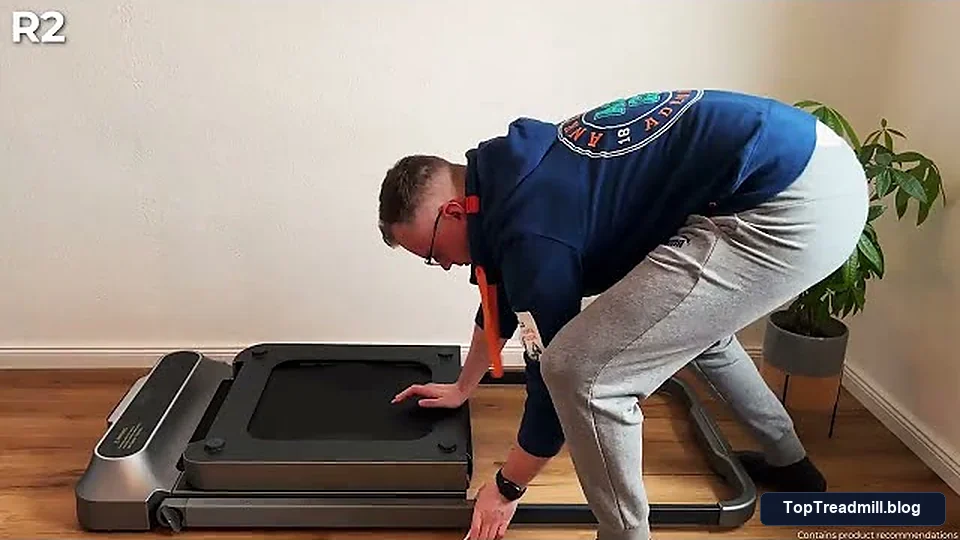
The double-fold architecture employed by our primary contender creates a remarkably compact footprint when fully collapsed. Engineers designed these joints to withstand repetitive mechanical stress without developing looseness.
As detailed in our Kingsmith Walkingpad X21 review, the unit utilizes an aluminum alloy frame engineered for maximum torsional rigidity during high-speed running sessions.
Motor placement also differs significantly between these units, as the X21 houses a robust brushless motor beneath the deck housing, whereas the R2 relies on a compact brushed motor optimized for lower speeds.
- Aluminum alloy chassis construction for weight reduction
- Proprietary 180-degree vs 90-degree folding joint designs
- Integrated structural load-bearing stress thresholds
- X21 employs a dual-fold mechanism with cast aluminum hinges.
- R2 features a single 180-degree fold with composite plastic joints.
Chassis Materials and Frame Rigidity
Frame deflection directly impacts user confidence during high-cadence walking or light running sessions. Rigorous engineering testing confirms that both models minimize lateral sway through reinforced cross-members.
Selecting appropriate structural adhesives and precision welds prevents frame fatigue over thousands of operating cycles. Users will notice a solid platform feel underfoot despite the folding nature.
- Precision-welded steel and aluminum reinforcement points
- Calculated torsional rigidity ratings for running decks
Real-World Performance Comparison
Highlighted in our Kingsmith R2 review, motor output and belt response dictate how smoothly a walking pad transitions between speeds using quiet brushless technology.
Users stepping onto these belts will experience distinct speed ceilings and acceleration curves. Real-world testing highlights noticeable differences in torque delivery when stepping near the front motor cowl.
Operating at higher velocities, the X21 delivers consistent belt tracking up to 12 kilometers per hour, minimizing lateral drift even when foot strike mechanics vary under heavy user loads.
Conversely, the R2 excels during sustained walking intervals capped at 6 kilometers per hour, delivering smooth low-end torque without noticeable motor stutter or thermal throttling during extended sessions.
- Brushless versus brushed motor thermal efficiency metrics
- Maximum velocity ceilings ranging from 6.2 to 7.4 mph
- Torque consistency during sudden cadence adjustments
- X21 supports running strides up to 45 inches effectively.
- R2 is strictly calibrated for walking strides under 40 inches.
Motor Torque and Speed Thresholds
Delivering consistent belt velocity requires robust pulse-width modulation controllers. The higher-tier unit maintains speed accuracy even when subjected to heavy foot strikes from heavier runners.
Evaluating thermal buildup during extended sessions reveals efficient heat dissipation in both designs. Safety cutoffs engage reliably if friction exceeds nominal operating parameters.
- Pulse-width modulation motor controller responsiveness
- Sustained thermal management during prolonged workouts
Ergonomics and Interface Usability
User interfaces dictate how effortlessly you can adjust speed mid-stride without breaking concentration. Digital integration varies dramatically between these two specific models.
The inclusion of a physical handrail on one unit transforms the ergonomic profile entirely. Foot-sensing speed control technology remains a core feature across both fitness platforms.
Integrated console design on the X21 features an LED digital display embedded directly into the metallic crossbar, providing immediate visual feedback on speed, time, distance, and calories burned.
The R2 adopts a minimalist approach by placing its status indicator lights near the motor housing, forcing users to rely on the KS Fit mobile app for detailed metrics.
- Integrated digital LED readouts embedded within handrails
- Foot-sensing automatic zone speed acceleration algorithms
- Handheld remote control ergonomics and connectivity range
- X21 includes a physical rotary dial for precise speed adjustments.
- R2 utilizes automatic foot-sensing speed zones for pace control.
Display Integration and Control Layouts
Clear metric visibility prevents user fatigue and enhances safety during intense workout sessions. High-contrast LED matrices display time, distance, and speed clearly under bright office lighting.
Tactile button feedback on remote controls ensures positive engagement without requiring constant visual confirmation. Wireless pairing stability remains robust across standard operating distances.
- High-contrast LED matrix visibility under ambient light
- Wireless frequency pairing reliability and latency
Storage Footprint and Mobility Engineering
According to our Kingsmith X21 review, space-saving engineering defines the modern walking pad category for urban residential environments, where folding dimensions dictate easy storage beneath standard furniture.
Transport wheels facilitate effortless relocation across hardwood floors and low-pile carpeting alike. Balancing weight distribution ensures users can tilt and roll the units safely.
When folded, the X21 reduces its overall length by half through a proprietary hinge system, leaving a remarkably compact vertical storage footprint that easily slips into narrow closet spaces.
Similarly, the R2 features dual transport wheels and a low-profile chassis designed specifically for horizontal slide-under storage beneath standard living room sofas or raised bed frames.
- Folded height clearance requirements under low furniture
- Integrated transport wheel durability and rolling resistance
- Vertical freestanding stability without wall mounting brackets
- X21 requires a wall tether when stored upright for safety.
- R2 can rest flat against baseboards without wall anchors.
Folded Dimensions and Clearance Metrics
Accurate spatial planning requires understanding precise clearance dimensions in both operating and storage configurations. Low-profile decks slide seamlessly into tight gaps without obstruction.
Vertical storage stands allow the equipment to occupy minimal floor space in small apartments. Locking mechanisms secure the folded frame safely during vertical storage periods.
- Exact millimeter clearance for under-sofa storage
- Secure upright locking latches for vertical positioning
Maintenance, Efficiency, and Longevity
Preventative maintenance preserves belt integrity and extends internal motor lifespan significantly. Routine silicone lubrication reduces friction coefficient values between the walking belt and deck.
Electrical efficiency ratings demonstrate modest power consumption during standard walking velocities. Standby power draw remains negligible when units stay plugged into wall outlets.
Routine upkeep for the X21 involves checking the running belt tension quarterly and applying silicone lubricant to the low-friction phenolic deck to prevent premature thermal wear on components.
The R2 demands similar lubrication intervals but emphasizes cleaning dust from its ventilation intake grilles to maintain optimal airflow across the internal control board and rectifier circuits.
- Silicone oil lubrication intervals for walking decks
- Running belt tension calibration and alignment procedures
- Electrical power draw profiles during active operation
- X21 motor brushes are rated for approximately 1500 operational hours.
- R2 brushless architecture eliminates brush wear entirely for longevity.
Belt Tensioning and Lubrication Protocols
Proper belt tracking prevents premature edge fraying and mechanical binding issues. Users should periodically check lateral alignment using the provided hex adjustment wrench.
Applying precise amounts of proprietary lubricant prevents thermal scoring on the phenolic deck surface. Following scheduled upkeep routines guarantees multi-year operational reliability.
- Hex wrench alignment adjustments for walking belts
- Phenolic deck surface protection via silicone oil
Safety Standards and Compliance Features
Safety certifications ensure mechanical and electrical systems meet rigorous international standards. Automatic standby modes engage when pressure sensors detect user absence on the belt surface.
Emergency stop lanyards provide immediate power interruption during unexpected slips or trips. Slow-start acceleration profiles prevent jarring velocity spikes upon initial startup.
Built to meet strict international safety certifications, the X21 includes an emergency stop lanyard that instantly cuts power to the drive motor if an accidental slip occurs.
The R2 relies on an automatic deceleration system that detects when a user drifts too close to the front console, gradually reducing speed to prevent tripping hazards.
- Automatic idle shutoff sensors for user absence detection
- Physical emergency stop tether attachment mechanisms
- Gradual acceleration ramps to prevent sudden slips
- X21 features child lock capabilities via the digital control panel.
- R2 incorporates overload protection to prevent electrical circuit overheating.
Automatic Stop Sensors and Safety Lanyards
Infrared or pressure-based zone detection accurately tracks user positioning along the belt. Stepping onto the front zone triggers acceleration while trailing zones initiate deceleration.
Testing safety systems regularly ensures prompt reaction times during emergency scenarios. Manufacturer guidelines emphasize wearing physical tethers during higher-speed running sessions.
- Zone-based optical or pressure acceleration triggers
- Emergency power cutoff response time verifications
Which Option Fits Your Setup
Selecting the ideal folding treadmill depends heavily on your primary fitness goals and available space. Walkers and light joggers will weigh speed limits against storage preferences carefully.
Evaluating your daily routine helps determine whether integrated handrails provide necessary stability. Making an informed purchase ensures long-term satisfaction with your indoor exercise investment.
Choosing between these models depends heavily on your cardio fitness goals, with the X21 serving runners who require higher speeds and a sturdier structural platform.
Drawing insights from our Kingsmith Walkingpad C2 review, users prioritizing compact storage will find this platform to be an ideal daily companion for home productivity.
- Matching maximum speed capabilities to user fitness levels
- Assessing office versus residential spatial constraints
- Balancing budget constraints against premium feature sets
- Select X21 if jogging forms a core part of your regimen.
- Select R2 if desk walking is your primary daily objective.
Matching Specifications to Daily Routines
Office workers utilizing standing desks benefit immensely from ultra-low profile walking platforms. Dedicated runners require the expanded speed range and structural stability of advanced frames.
Reviewing spatial dimensions in your intended workout area prevents post-purchase placement issues. Prioritize features that directly support your most frequent exercise habits.
- Standing desk clearance optimization for office users
- Running stride length accommodation for taller athletes
Frequently Asked Questions
What is the primary difference in top speed between these two folding treadmills?
The Kingsmith X21 achieves a maximum speed of 7.4 miles per hour suitable for light running, whereas the R2 maxes out at 6.2 miles per hour for walking.
Can both treadmills be stored completely vertically in small residential apartments?
Yes, both models feature innovative folding mechanisms that allow them to stand upright independently, though the R2 offers a slightly lower profile when completely flat.
How does the speed control mechanism function during active walking sessions?
Both units utilize integrated foot-sensing technology where stepping near the front accelerates the belt, while moving toward the rear decelerates the walking surface smoothly.
Do these folding treadmills require specialized tools for regular belt maintenance?
Routine upkeep only requires a standard hex wrench for alignment tweaks and regular applications of silicone oil to preserve the walking deck longevity.
Which model is better suited for intensive daily use under an adjustable standing desk?
The R2 excels in office environments due to its low-profile deck, while the X21 provides superior stability for users wanting faster paced workouts.