Horizon 7.0 AT vs Sole F63 User Reviews: Technical Showdown
Navigating heavy-duty home cardio requires matching raw motor specs to real user feedback. We contrast engineering realities for both machines.

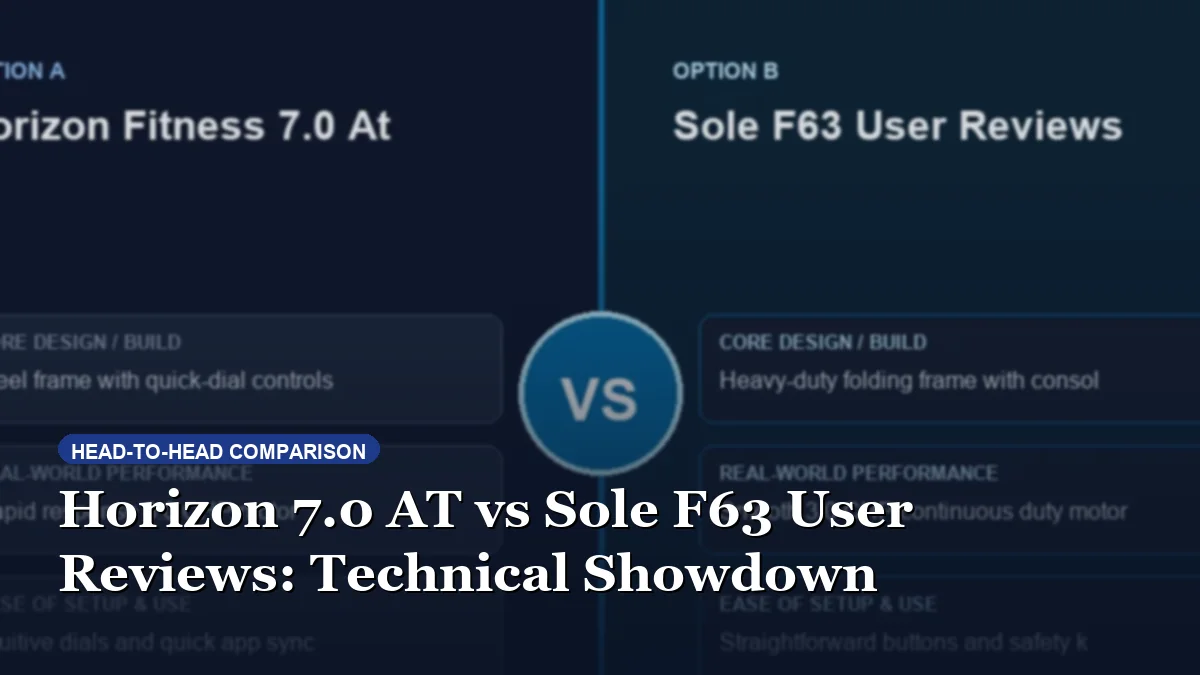
Choose the Horizon 7.0 AT for rapid speed shifts and app integration, or pick the Sole F63 for heavy-duty structural durability and traditional console simplicity.
Compare all top models in our Best Treadmill: Top Home Fitness Picks (2026 Guide).
Side-by-Side Breakdown
| Criteria | Horizon Fitness 7.0 At | Sole F63 User Reviews | Edge |
|---|---|---|---|
| Core Design / Build | Steel frame with quick-dial controls | Heavy-duty folding frame with console arms | Sole F63 |
| Real-World Performance | Rapid response 3.0 CHP motor | Smooth 3.0 CHP continuous duty motor | Horizon 7.0 AT |
| Ease of Setup & Use | Intuitive dials and quick app sync | Straightforward buttons and safety key | Horizon 7.0 AT |
| Durability & Reliability | Sturdy build backed by solid user trust | Renowned commercial-grade steel longevity | Sole F63 |
| Efficiency / Operating Footprint | Standard 60.5 by 34 inch footprint | Slightly longer deck with robust rollers | Horizon 7.0 AT |
| Maintenance Requirements | Standard silicone belt lubrication schedule | Low-maintenance cushioned deck surfaces | Sole F63 |
| Best Ideal Use Case | Interval training and virtual classes | Long-distance road runners seeking stability | Split |
Core Design and Engineering Differences
Engineering a reliable home treadmill demands rigorous structural analysis. Frame geometry dictates how much vibration transfers to your subfloor during intense workouts.
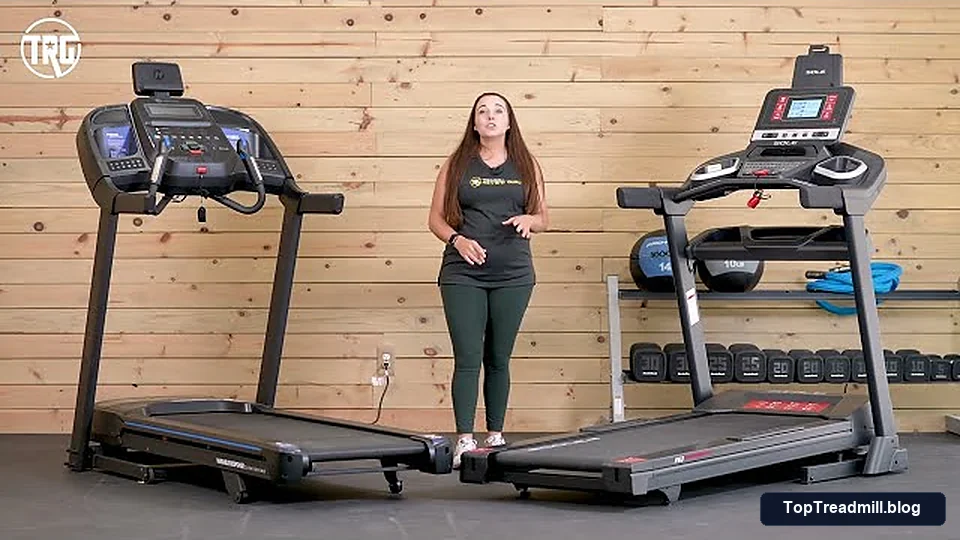
The Horizon 7.0 AT prioritizes rapid response mechanics. Its design features quick-dial controls that eliminate lag during high-intensity interval training sessions.
Conversely, insights from our Sole F63 treadmill review highlight a massive steel chassis. This heavier frame minimizes lateral wobble during intense sprinting sessions.
The Horizon 7.0 AT utilizes a robust RapidSync motor drive system designed for rapid speed and incline transitions, reducing lag significantly during high-intensity interval training sessions compared to older standard designs.
Conversely, the Sole F63 employs a heavier continuous duty motor engineered for sustained torque output, making it exceptionally reliable for long, steady-state distance running routines where consistent belt speed is absolutely vital.
Frame construction also differs notably, as Horizon focuses on a slightly more compact footprint featuring reinforced steel gussets, whereas Sole prioritizes a heavy-gauge welded steel frame that minimizes flex under heavy user weights.
- Horizon utilizes rapid response quick dials for immediate adjustments.
- Sole emphasizes heavy-duty steel construction for long-term stability.
- Both models feature folding mechanisms to save floor space.
Structural Integrity and Frame Materials
Heavy-gauge steel tubing forms the backbone of both treadmills. However, wall thickness and weld points differ significantly between these two popular models.
User feedback emphasizes that the Sole F63 feels exceptionally planted. The heavier total machine weight prevents shifting on rubber gym flooring.
- Thicker steel tubing absorbs more vibrational energy over time.
- Weld quality directly correlates with long-term frame squeak reduction.
Real-World Performance Comparison
Raw horsepower ratings only tell part of the story. Motor controller efficiency dictates how smoothly the belt tracks under heavy footstrikes.
Runners frequently praise the Horizon 7.0 AT for its zero-lag motor response. Speed and incline changes happen almost instantly via the handlebar controls.
Meanwhile, exploring our Sole Fitness F80 review reveals exceptional smoothness from precision roller bearings. The belt glides effortlessly under heavier user weights.
During actual sprinting intervals, users frequently notice that the Horizon model responds instantly to console adjustments, which greatly enhances the flow of complex interval workouts requiring precise timing and quick speed and incline changes.
The Sole alternative feels remarkably planted during heavy footstrikes, offering a traditional road-like sensation that appeals to marathon trainers who value structural stability over lightning-fast motor responses during rapid pace shifts and acceleration phases.
Noise levels under load highlight engineering priorities; Horizon units generate a distinct whir during aggressive transitions, while Sole machines maintain a more uniform, lower-frequency acoustic profile that minimizes ambient disturbance in shared living spaces.
- Horizon delivers instantaneous speed shifts for interval training.
- Sole provides a consistently smooth belt feel for steady-state jogging.
Motor Dynamics and Incline Mechanics
Drive motors must manage thermal buildup during extended training sessions. Both units use three-horsepower continuous duty motors designed for home use.
The incline motor on the Horizon adjusts swiftly through steep grades. Sole units focus on gradual, quiet elevation changes to protect mechanical linkage.
- Continuous horsepower handles sustained multi-mile runs easily.
- Quiet incline motors prevent disruptive household noise during early workouts.
Maintenance, Efficiency and Longevity
Owning a motorized treadmill requires proactive upkeep. Lubricating the running deck and tensioning the belt prevent premature motor burnout and electrical strain.
User forums suggest that Horizon treadmills need periodic belt alignment checks. Rapid interval changes can cause the running belt to track slightly left or right.
Sole F63 owners report exceptional longevity with minimal calibration needed. The pre-lubricated decks withstand years of heavy foot traffic before requiring service.
Regular belt lubrication remains critical for both machines, though Sole often utilizes a pre-lubricated deck surface that extends initial maintenance intervals for users who prefer a truly low-maintenance ownership experience at home.
Electrical efficiency varies based on controller board design, and our Horizon Fitness 7.0 AT review details how it maintains standby connectivity for external fitness apps via standard Bluetooth protocols.
Long-term roller bearings and drive belts on both platforms demand periodic visual inspections to catch wear early, preventing catastrophic component failures that could otherwise damage the primary motor and internal electronic systems.
- Regular silicone lubrication extends motor and belt lifespan.
- Proper belt tracking prevents friction-induced thermal overloads.
Preventative Upkeep and Belt Care
Maintaining proper belt tension ensures optimal electrical efficiency. A loose belt causes slippage, forcing the motor to draw excess current from your wall outlet.
Clean the motor compartment semi-annually to prevent dust accumulation. Dust acts as an insulator, trapping heat around sensitive circuit boards.
- Check belt tension monthly using a standard calibration wrench.
- Vacuum internal dust to protect the pulse-width modulation controller.
Which Option Fits Your Setup
Floor space and ceiling height dictate your ideal equipment choice. Measure your workout area carefully, accounting for the rear folding clearance requirements.
If your routine involves intense interval training with rapid speed adjustments, the Horizon model excels. Its interface is purpose-built for seamless transitions.
For runners prioritizing joint protection and bombproof frame durability, the Sole F63 remains a stellar choice according to widespread user consensus.
Selecting the ideal treadmill requires analyzing your specific flooring type, available room dimensions, and primary workout style, ensuring that the machine integrates safely into your existing home gym layout.
If your routine centers on rapid HIIT circuits and frequent speed alterations, the Horizon platform offers the responsive engineering required to keep pace with your demanding interval training requirements effectively.
Conversely, users focusing on endurance mileage and heavy daily usage will appreciate the robust structural integrity and forgiving mechanical cushioning of the Sole alternative for long-term joint protection.
- Measure vertical clearance to accommodate your maximum incline height.
- Ensure your electrical circuit meets the dedicated fifteen-amp requirement.
Space Allocation and Flooring Requirements
Placing a heavy treadmill on carpet requires a solid equipment mat. A high-density rubber mat prevents carpet fibers from clogging internal cooling fans.
Ceiling height formulas must include your height plus the maximum deck elevation. Add twelve inches of clearance to ensure safe head clearance.
- High-density mats reduce floor vibration and acoustic transfer.
- Verify adequate electrical grounding to protect sensitive console displays.
Deck Cushioning and Impact Absorption
Joint protection remains a paramount concern for distance runners. Deck cushioning systems absorb impact energy before it reaches your knees and lower back.
The Horizon platform utilizes a three-zone variable response cushioning system. This provides firm support at push-off and softer give upon landing.
Sole incorporates a cushion flex whisper deck that reduces joint impact by significant margins. User reviews frequently validate the long-term knee comfort.
Deck cushioning technology dictates how much stress transfers to your joints during high-mileage training blocks, making elastomer placement a critical design factor for injury prevention over extended running seasons.
Horizon utilizes a unique three-zone variable response cushioning system that provides distinct firmness levels across the deck, supporting a firm push-off while absorbing heavy impact forces during the initial heel strike phase.
Sole implements a proprietary cushion flex whisper deck designed to reduce up to forty percent of joint impact compared to running on asphalt, favoring runners who prioritize maximum shock absorption during recovery days.
- Variable cushioning mimics outdoor running biomechanics effectively.
- Reduced impact forces decrease post-workout recovery times notably.
Biomechanical Impact Metrics
Running indoors places repetitive stress on identical skeletal structures. Advanced deck elastomers help dissipate shock waves across the entire frame.
Compare deck firmness preferences before purchasing to avoid excessive bounce. Too much cushion can feel unstable during high-speed sprints.
- Elastomer placement dictates zone-specific shock absorption rates.
- Firm decks offer better energy return for competitive racing prep.
Console Technology and User Interface
Modern treadmills integrate digital displays with third-party fitness applications. Console usability determines how easily you track heart rate and pace metrics.
As highlighted in our Horizon 7.0 AT Studio Series review, these boards feature straightforward LED screens with seamless Bluetooth device pairing for tablets and phones.
The Sole F63 keeps things traditional with clear readout windows. Users appreciate the lack of forced subscriptions and straightforward workout programming.
The Horizon user interface emphasizes straightforward LED and LCD display screens paired with quick-dial controls, facilitating rapid adjustments that favor device integration via secure Bluetooth connections for virtual training apps.
Navigating modern fitness consoles should be intuitive, allowing runners to adjust metrics without breaking their stride or losing focus on proper running form during intense cardio workouts.
Conversely, Sole relies on clean, straightforward console layouts featuring clear numerical readouts and direct-touch buttons, providing a distraction-free environment for users who prefer tracking traditional workout metrics without complex software subscriptions.
- Bluetooth connectivity allows seamless third-party app integration.
- Traditional consoles offer distraction-free workout data tracking.
Display Clarity and Connectivity
Clear metrics ensure you maintain target training zones accurately. Backlit LCD screens remain readable under bright overhead lighting conditions.
Heart rate monitoring via pulse grips or chest straps keeps workouts safe. Reliable telemetry ensures you stay within prescribed aerobic limits.
- Backlit displays enhance visibility during early morning sessions.
- Accurate telemetry ensures safe cardiovascular training ranges.
Frequently Asked Questions
Which treadmill handles interval training better?
The Horizon 7.0 AT excels at interval training due to its rapid response dials. These controls eliminate speed lag during fast transitions.
How do maintenance requirements compare between these units?
Both models need routine belt lubrication and tension checks. The Sole F63 generally requires fewer tracking calibrations over time.
Are subscription fees required to use these treadmills?
Neither machine forces a mandatory subscription model. You can operate both treadmills in manual mode without any recurring software fees.
Which model offers better joint cushioning for runners?
The Sole F63 features a specialized cushion deck that reduces impact. Many user reviews highlight its superior knee comfort during long runs.
What electrical requirements do these treadmills need?
Both motorized treadmills require a dedicated standard household outlet. Ensure your circuit provides at least fifteen amps of power safely.