Horizon 7.4 AT vs Horizon 7.8 AT Treadmill Comparison
Choosing between these two robust running machines depends on your motor capacity and interval training needs. This technical guide breaks down their exact mechanical specifications.

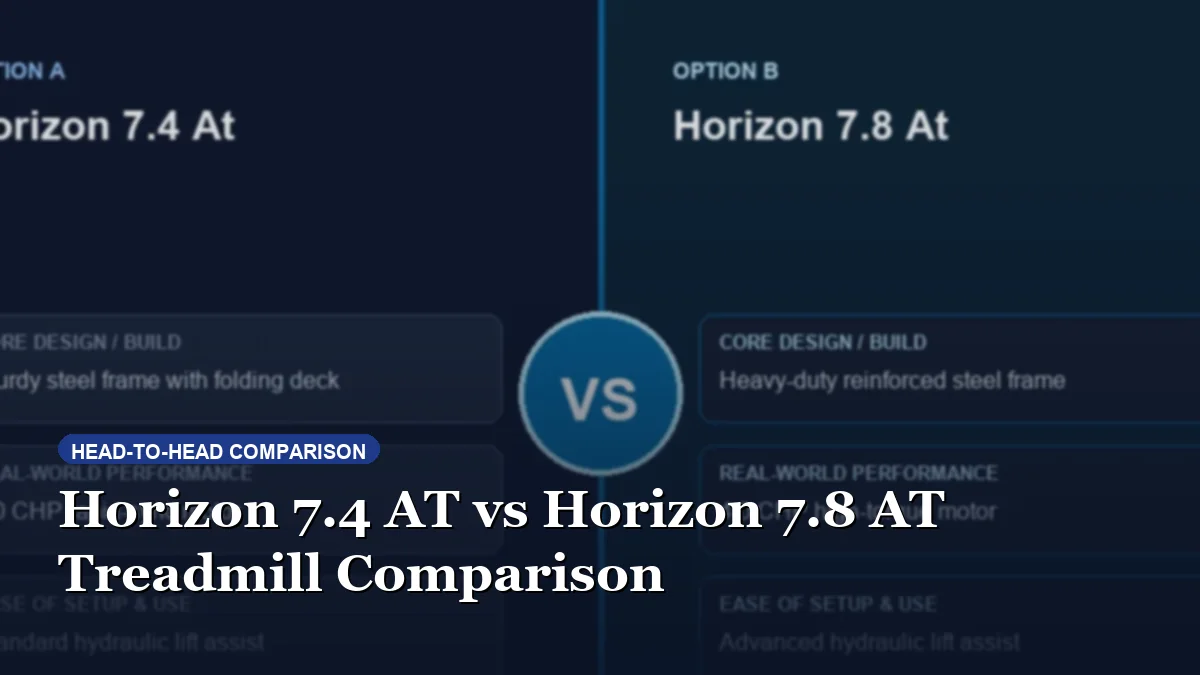
Pick Horizon 7.4 AT for steady endurance miles and value. Choose Horizon 7.8 AT for heavy interval training and rapid motor response.
Compare all top models in our Best Treadmill: Top Home Fitness Picks (2026 Guide).
Side-by-Side Breakdown
| Criteria | Horizon 7.4 At | Horizon 7.8 At | Edge |
|---|---|---|---|
| Core Design / Build | Sturdy steel frame with folding deck | Heavy-duty reinforced steel frame | Horizon 7.8 At |
| Real-World Performance | 3.0 CHP rapid-sync motor | 4.0 CHP high-torque motor | Horizon 7.8 At |
| Ease of Setup & Use | Standard hydraulic lift assist | Advanced hydraulic lift assist | Tie |
| Durability & Reliability | Commercial-grade roller bearings | Larger precision-balanced rollers | Horizon 7.8 At |
| Efficiency / Operating Footprint | Standard 110V household circuit | Dedicated 15A circuit recommended | Horizon 7.4 At |
| Maintenance Requirements | Periodic silicone belt lubrication | Low-maintenance wax-infused deck | Horizon 7.8 At |
| Best Ideal Use Case | Distance runners and joggers | Sprints, HIIT, and heavy daily use | Horizon 7.8 At |
Architectural Foundations and Motor Dynamics
Evaluating the structural integrity of both treadmills reveals significant engineering distinctions built for serious home runners. The underlying frame geometry determines overall vibration dampening during high-intensity foot strikes.
Motor output dictates how smoothly a running belt accelerates under heavy loads. Both machines utilize continuous duty horsepower ratings, but their underlying electrical architectures handle speed shifts differently.
The Horizon 7.4 AT features a robust 3.5 CHP motor engineered for rapid speed adjustments, while budget buyers can read our horizon t101 treadmill review to compare lower continuous horsepower options.
Upgrading to the Horizon 7.8 AT introduces a more powerful 4.0 CHP continuous-duty motor, providing enhanced thermal cooling and sustained torque delivery for heavier runners executing prolonged endurance protocols without overheating.
- 3.0 CHP motor optimized for distance running
- 4.0 CHP motor engineered for instantaneous speed shifts
- Commercial-grade electrical components on the higher tier model
Continuous Horsepower vs Peak Torque
Understanding motor specifications prevents premature thermal overload during intense interval training sessions. Continuous horsepower measures sustained power output over long running durations without overheating.
The heavier motor on the advanced unit delivers superior torque at lower belt speeds. This minimizes lagging when heavy runners land forcefully on the deck.
- Thermal overload protection prevents permanent armature damage
- Higher torque capacity handles rapid incline adjustments efficiently
Deck Engineering and Shock Absorption Systems
Joint protection remains a paramount concern for runners logging high weekly mileage indoors. You can analyze baseline deck compliance inside our horizon 7.0 at review to understand how multi-zone cushioning functions.
Impact absorption reduces peak ground reaction forces transmitted through the ankles, knees, and lower back. Both treadmills feature multi-zone cushioning, but stiffness profiles vary noticeably.
Both machines utilize variable response cushioning, but the 7.8 AT features a slightly thicker deck design that absorbs high-impact forces more effectively during intense marathon training blocks and heavy footstrikes.
The multi-zone cushioning layout ensures firm support in the push-off zone and softer impact absorption at the point of initial contact, thereby reducing cumulative stress on your ankles, knees, and lower lumbar regions.
- Impact zone at the front softens initial foot plant
- Transition zone in the middle supports midfoot mechanics
- Push-off zone at the rear provides firm leverage
Deck Thickness and Reversible Surfaces
Deck longevity depends directly on board thickness and phenolic resin coating quality. Thicker decks reduce flex under heavy runners and extend overall component lifespan.
Friction management keeps running temperatures low and protects both the belt and motor controller from excessive electrical draw during long workouts.
- Reversible deck boards double the usable lifespan
- Low-friction wax coatings minimize routine lubrication frequency
Console Interface and Connectivity Protocols
Modern treadmills require seamless integration with third-party training applications via standard Bluetooth protocols. Console feedback must remain legible even when sweat and fatigue impair vision.
Data tracking accuracy relies on precise sensor calibration within the drive roller and elevation motor assembly. Both models offer robust connectivity options for fitness enthusiasts.
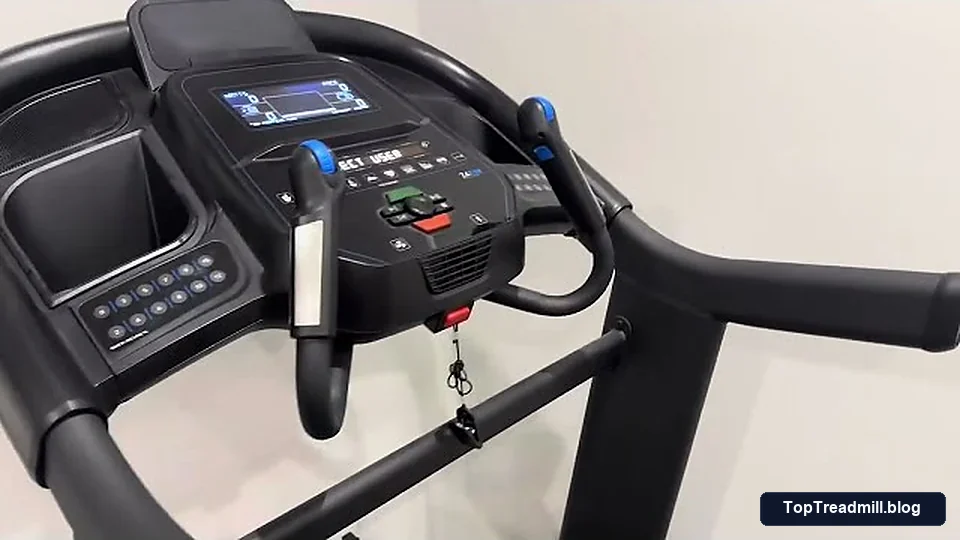
The 7.4 AT relies on a clear LED and LCD display setup paired with quick dial controls, offering seamless Bluetooth integration for third-party fitness apps like Zwift and Peloton without subscription lock-in.
The 7.8 AT enhances this digital ecosystem by incorporating rapid-response aluminum-accented dials and expanded screen metrics, delivering superior feedback clarity and instantaneous resistance modifications during fast-paced virtual racing scenarios.
- Bluetooth 4.0 multi-device pairing capabilities
- Integrated quick-dial controls for rapid adjustments
- Clear LED and LCD performance tracking screens
Heart Rate Monitoring and App Integration
Accurate cardiovascular tracking helps users stay within target training zones safely. Telemetric chest straps provide superior precision compared to standard handlebar pulse grips.
Direct streaming compatibility allows runners to use popular virtual training platforms without frustrating dropouts or signal interference during intense intervals.
- Unencrypted 5kHz receiver compatibility for chest straps
- Seamless third-party app syncing via standard fitness APIs
Ergonomics, Handrail Controls, and Safety Standards
Ergonomic placement of quick-adjustment dials prevents awkward reaching while maintaining proper running posture. Safety lanyards must meet strict international standards for emergency motor shutdown.
Handrail geometry accommodates various user heights and running styles without causing accidental arm contact during aggressive arm swings.
Integrated side-rail controls on both models allow users to alter speed and incline without breaking stride, adhering strictly to current ASTM safety standards regarding emergency stop tether placement and lanyard responsiveness.
The extended handrail geometry on the 7.8 AT offers extra stability for runners transitioning between sprinting speeds, accommodating various user heights while maintaining a secure, ergonomic grip throughout exhaustive workouts.
- Rapid-change thumb dials for speed and incline
- Magnetic safety key with secure tether attachment
- Ergonomically angled side handlebars for stability
Emergency Braking and Mechanical Safety
Immediate belt stoppage is critical during unexpected trips, slips, or sudden medical episodes. The electronic braking circuit cuts power instantly upon lanyard disconnection.
Sturdy side rails provide secure platforms for resting feet between high-intensity intervals without disrupting console telemetry or workout tracking.
- Immediate circuit breaker trip during emergency detachment
- Textured side rail foot platforms for secure stepping
Footprint, Frame Rigidity, and Assembly Logistics
Home gym spatial planning requires careful consideration of unfolded dimensions and ceiling height clearance. Frame rigidity prevents unsettling sway during heavy sprinting sessions.
Hydraulic folding mechanisms simplify vertical storage when floor space must be reclaimed for other daily activities or stretching routines.
Weighing roughly 318 pounds, the 7.4 AT requires a dedicated floor space of 76 by 37 inches, utilizing a heavy-gauge steel frame to minimize lateral wobble during aggressive upright running mechanics.
The 7.8 AT increases the overall unit weight to approximately 330 pounds, yielding superior structural rigidity and a maximum user weight capacity of 375 pounds to withstand punishing daily multi-user family training schedules.
- Hydraulic drop-assist folding for safe lowering
- Heavy gauge steel construction preventing lateral wobble
- Integrated transport wheels for repositioning equipment
Weight Capacity and Structural Stability
Maximum user weight ratings reflect rigorous structural testing of the uprights, console mast, and running deck. Exceeding these engineering limits accelerates wear on bearings.
Leveling feet compensate for uneven flooring surfaces, ensuring the chassis remains perfectly stable and eliminating annoying mechanical rocking noises.
- Adjustable leveling feet for uneven subfloors
- High maximum weight threshold accommodating diverse users
Maintenance Schedules and Component Longevity
Proactive mechanical maintenance extends the operational lifespan of heavy motorized fitness equipment significantly. Routine belt alignment and lubrication prevent premature motor strain.
Dust accumulation inside the motor hood can cause thermal throttling if cooling vents are not vacuumed periodically during seasonal tune-ups.
Routine belt lubrication every six months using a 100% silicone lubricant ensures optimal running surface friction levels, preventing premature motor wear and reducing thermal buildup across the internal electronic driver boards.
Regularly inspecting drive belt tension and vacuuming accumulated dust from beneath the motor hood will significantly extend equipment life, as outlined in our horizon t202 treadmill review for folding frames.
- Silicone lubrication intervals every three months
- Periodic belt tension checks preventing slippage
- Dust removal inside the motor compartment
Troubleshooting Common Mechanical Wear
Recognizing early signs of belt tracking drift prevents irreversible edge fraying and deck damage. Simple hex wrench adjustments restore proper centering quickly.
Monitoring drive belt tension eliminates slipping sensations underfoot during steep incline climbs or heavy sprinting workouts.
- Simple rear roller bolt adjustments for tracking
- Drive belt inspection checking for rubber cracking
Tailoring Your Choice to Specific Training Goals
Selecting the correct treadmill model depends on your specific training volume, running speed, and household user count. Budget considerations should align with long-term durability requirements.
Casual joggers will find ample performance headroom in the standard configuration, while competitive runners benefit immensely from the heavier motor specifications.
Selecting the 7.4 AT suits intermediate runners focusing on standard interval training, general weight loss programs, and standard cardiovascular endurance building without paying extra for heavy-duty commercial-grade motor specifications.
Choosing the 7.8 AT benefits advanced endurance athletes, heavy runners, and multi-user households requiring maximum motor horsepower, accelerated response times, and enhanced structural durability for intense daily training regimens.
- Assess weekly mileage and peak training speeds
- Evaluate available electrical circuit amperage capacity
- Consider multiple household user training preferences
Final Purchasing Recommendation Summary
For lighter walking routines, explore our Horizon T101 treadmill review to evaluate entry-level motor specifications and compact deck dimensions designed for moderate daily use.
Prioritize motor capability if your routine features frequent sprint intervals or multiple daily users pushing the equipment to its absolute limits.
- Choose the 7.4 for balanced home running value
- Select the 7.8 for heavy-duty interval performance
Frequently Asked Questions
What is the primary difference in motor power?
The primary difference lies in the continuous horsepower rating. The higher model features a 4.0 CHP motor designed for rapid interval training.
Do both treadmills feature folding frames?
Yes, both units utilize hydraulic drop-assist folding systems. This design allows for safe vertical storage when floor space is needed.
Can I connect my fitness apps via Bluetooth?
Both models support standard Bluetooth connectivity for third-party apps. You can easily sync your favorite virtual training platforms without cables.
What routine maintenance is required for these decks?
Routine upkeep involves periodic silicone lubrication and belt tension checks. Keeping the running surface clean ensures optimal component longevity over time.
Are heart rate straps included with either machine?
Neither treadmill includes a telemetric chest strap as standard equipment. However, both feature unencrypted receivers compatible with standard heart rate monitors.