Curved Treadmill vs Flat: Technical Performance Breakdown
Choosing between a self-powered curved deck and a motorized flat belt changes your entire workout experience. This technical guide compares mechanics, maintenance, and training outcomes to help you select the ideal fitness machine.

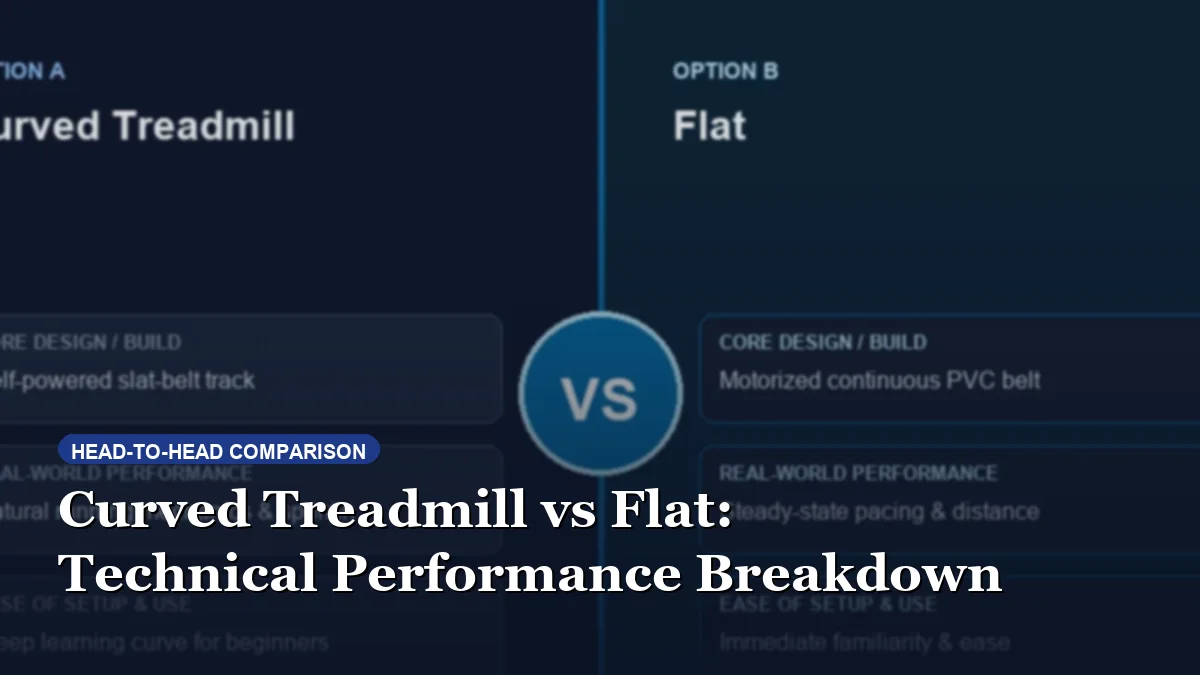
Choose a curved model if you prioritize high-intensity interval training and natural running mechanics. Select a flat motorized unit if you need precise speed regulation for endurance training and long-distance marathon preparation.
Compare all top models in our Best Treadmill: Top Home Fitness Picks (2026 Guide).
Side-by-Side Breakdown
| Criteria | Curved Treadmill | Flat | Edge |
|---|---|---|---|
| Core Design / Build | Self-powered slat-belt track | Motorized continuous PVC belt | Curved Treadmill |
| Real-World Performance | Natural running mechanics & sprinting | Steady-state pacing & distance | Flat |
| Ease of Setup & Use | Steep learning curve for beginners | Immediate familiarity & ease | Flat |
| Durability & Reliability | Fewer moving mechanical parts | Complex electronics & motor wear | Curved Treadmill |
| Efficiency / Operating Footprint | Zero electrical power required | High electrical draw under load | Curved Treadmill |
| Maintenance Requirements | Minimal debris cleaning & bearings | Frequent belt tension & lubrication | Curved Treadmill |
| Best Ideal Use Case | Sprint intervals & athletic conditioning | Endurance runs & rehab walking | Flat |
Core Design and Mechanical Architecture
Curved treadmills rely on a distinct slat-belt design driven entirely by the user's foot strike. This mechanical difference removes the need for an internal drive motor, altering how momentum builds and dissipates during strides.
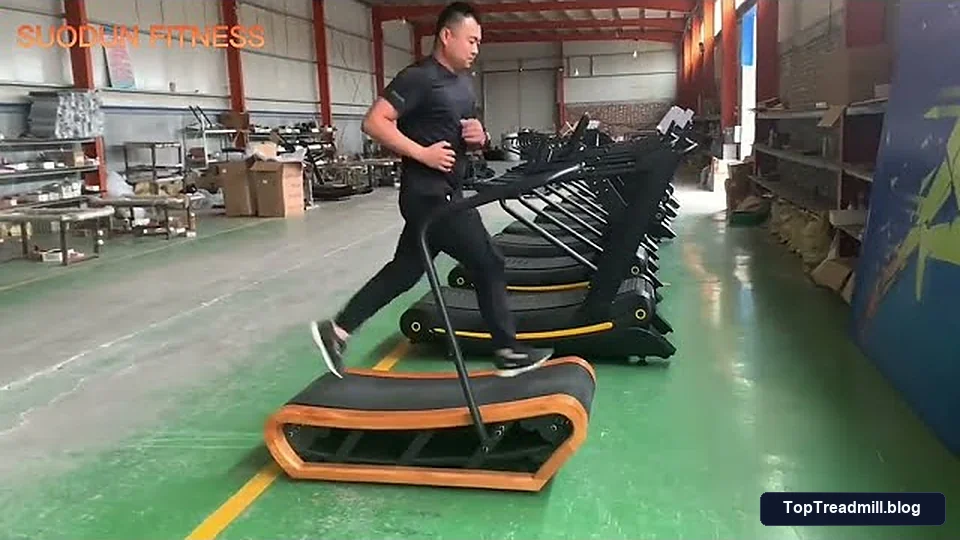
Traditional flat treadmills use a continuous PVC belt wrapped over front and rear rollers. An electric drive motor powers this belt at a constant velocity, forcing runners to match the pre-set speed of the equipment.
Understanding these structural foundations helps users anticipate how each machine responds to foot placement. The curved geometry naturally encourages a forefoot strike, whereas flat belts accommodate diverse heel-to-toe running styles without mechanical penalties.
- Curved units utilize manual slat tracks with zero motor assistance.
- Flat models depend on continuous-duty electric motors and drive rollers.
- Slat configurations absorb high impact forces during explosive workouts.
Slat-Belt Construction versus Continuous PVC Loops
Curved units utilize curved slats made from high-density rubber or aluminum. These materials absorb impact forces while providing exceptional traction during explosive sprinting drills and heavy conditioning sessions.
Flat treadmills feature multi-ply running belts stretched across low-friction decks. This traditional configuration minimizes surface vibration, offering a smoother feel during steady-state jogging and moderate incline walking.
- Rubberized slats offer superior grip during sprinting.
- Multi-ply belts provide stable traction for jogging.
Drive Mechanisms and Power Transmission
We evaluate the best curved manual treadmill options to eliminate cords entirely. Your body weight drives the slat belt downward and backward to generate immediate forward propulsion without electrical resistance.
Motorized flat trainers depend on continuous alternating current or direct current motors. These internal components regulate belt speed through heavy flywheels, requiring stable wall power to maintain consistent operational velocities.
- Kinetic energy drives manual curved belt rotation.
- Internal flywheels stabilize motorized flat belt speeds.
Biomechanics and Running Dynamics
Running on a curved surface forces a higher knee drive and engages posterior chain muscles more aggressively. Your hamstrings and glutes work harder to propel the curved belt downward with every single stride.
Flat motorized treadmills allow passive limb recovery since the motor pulls the belt backward. Runners focus primarily on maintaining cadence rather than generating the horizontal force required to move a dead belt.
Joint loading also differs significantly between these two configurations. Curved designs reduce impact shock through specialized slat cushioning, while flat decks rely on elastomer cushioning systems beneath the running platform.
- Curved decks increase hamstring and glute activation.
- Flat belts permit passive leg recovery during strides.
- Specialized cushioning dampens repetitive joint impact.
Posterior Chain Engagement and Stride Angle
Even when shopping the best treadmill for cheap, proper ergonomic design matters. The upward slope at the front of a curved deck forces you to strike closer to your center.
Flat surfaces encourage longer, more relaxed strides because the motorized belt assists leg turnover. While this is comfortable for distance runners, it can sometimes promote overstriding and increased heel-strike impact forces.
- Front curves encourage optimal midfoot strike positions.
- Motorized belts can inadvertently encourage overstriding.
Impact Absorption and Joint Stress Profiles
Rubberized slats on manual curved trainers absorb considerable high-frequency shock loads. This dampening effect protects your ankles and knees during heavy plyometric workouts and repeated sprint intervals.
Advanced flat decks incorporate adjustable elastomer cushions to absorb shock across varying intensity levels. Users can soften the deck impact to mimic grass or firm it up for road-running simulations.
- Slat surfaces mitigate high-frequency shock effectively.
- Adjustable elastomers alter running deck firmness.
Velocity Control and Acceleration Response
If you choose the best home treadmill for running, acceleration is entirely self-regulated by your physical effort. Moving toward the front increases speed instantly, while stepping backward slows the belt.
Flat motorized treadmills require manual button presses or console commands to alter velocity. This delay introduces a slight lag during interval training transitions where rapid speed changes dictate workout effectiveness.
Top-end speeds on manual units are limited only by your physical capacity. Conversely, motorized flats have strict maximum speed thresholds governed by their internal horsepower and electronic controller limitations.
- User foot placement directly controls curved belt velocity.
- Console buttons govern flat treadmill speed changes.
- Physical capacity dictates top speeds on manual trainers.
Instantaneous Speed Transitions in Intervals
High-intensity interval training thrives on the immediate response of curved systems. You can transition from a slow walk to an all-out sprint in fractions of a second without pressing buttons.
Interval sessions on motorized flat units require patience as the motor ramps up. Even premium commercial motors take a few seconds to accelerate from walking paces to maximum sprint speeds.
- Instant acceleration suits demanding interval workouts.
- Motor lag delays rapid speed transitions on flats.
Maximum Velocity Limits and Safety Stops
Manual curved machines lack an electronic governor to limit maximum runner velocity. Your legs dictate the absolute ceiling, making proper running form essential to prevent accidental loss of footing.
Flat motorized models feature safety lanyards and programmed maximum speed caps. These built-in safeguards prevent catastrophic falls by halting the running belt immediately if the user stumbles or loses balance.
- Manual units lack electronic speed restriction caps.
- Safety lanyards provide immediate emergency belt stops.
Power Delivery and Energy Consumption
Zero electrical consumption makes curved treadmills exceptionally energy-efficient appliances. You can place these units anywhere in your home without worrying about dedicated circuit breakers or trailing extension cords.
Motorized flat treadmills consume substantial household electricity, especially during high-speed running. Powerful continuous-duty motors draw significant wattage under load, which can impact your monthly utility bills during heavy usage periods.
Electrical independence also means curved trainers remain fully operational during neighborhood power outages. Flat units require stable grid power just to illuminate the console display and adjust incline settings.
- Curved trainers require zero electrical plug connections.
- Motorized units draw significant continuous household power.
- Manual machines operate reliably during power grid failures.
Electrical Independence and Placement Flexibility
Without power cords restricting movement, you can position curved treadmills in garages or patios. This spatial freedom benefits users who want to configure their home gyms away from crowded wall outlets.
Motorized units are permanently anchored near heavy-duty grounded electrical outlets. Running these high-draw appliances through standard extension cords can cause voltage drops and potential damage to internal motor controllers.
- Cordless designs allow placement in remote room areas.
- Motorized decks demand dedicated grounded wall circuits.
Operational Costs and Environmental Impact
The carbon footprint of a manual treadmill is essentially limited to manufacturing emissions. There are no standby power draws or phantom electrical loads consuming energy while the machine sits idle.
Flat treadmills draw continuous standby power for their touchscreens and wireless receivers. Over years of operation, this idle power consumption adds up alongside active running electricity usage on your utility bill.
- Manual trainers generate zero phantom standby power.
- Consoles draw continuous electrical current while idle.
Maintenance Routines and Component Wear
Curved treadmills boast simpler mechanical layouts with fewer moving parts to fail. There are no drive belts, motor brushes, or complex circuit boards requiring specialized technical troubleshooting or replacement over time.
Flat treadmills require regular belt alignment, deck lubrication, and motor maintenance. Neglecting these essential upkeep tasks leads to premature deck wear, increased friction, and costly electrical component failures down the road.
Bearing assemblies on curved slat tracks demand periodic inspection to prevent squeaking. However, this routine upkeep is generally straightforward and requires minimal mechanical expertise compared to servicing electronic treadmill drives.
- Curved frames feature simplified mechanical components.
- Flat units require ongoing lubrication and belt tuning.
- Bearing inspections prevent squeaks on slat tracks.
Slat-Belt Durability versus Traditional Belt Maintenance
Individual slats on curved units rarely require complete replacement unless damaged by impacts. Most systems feature modular designs where individual slats can be swapped out independently during routine servicing.
Traditional running belts stretch over time and require tension adjustments with a hex wrench. Once the belt surface develops cracks or excessive fraying, the entire continuous loop must be replaced entirely.
- Modular slats allow targeted individual replacements.
- Continuous belts require periodic tension wrench adjustments.
Motor Servicing and Electronic Troubleshooting
Electronic speed controllers on flat treadmills are vulnerable to power surges. Diagnosing error codes and replacing faulty inverter boards often necessitates professional technician visits and expensive replacement components.
Because manual curved trainers lack circuit boards, electronic troubleshooting is virtually nonexistent. Maintenance is restricted to cleaning debris from the curved tracks and tightening visible structural frame bolts.
- Inverter boards demand professional diagnostic servicing.
- Manual systems eliminate complex electrical troubleshooting.
Spatial Footprint and Ergonomics
Curved treadmills typically feature heavy steel frames that maximize stability during aggressive sprints. This robust construction makes them heavier and more challenging to reposition within tight residential spaces.
Flat motorized units often incorporate folding hydraulic decks for compact storage. This space-saving engineering allows users to reclaim floor space in smaller spare bedrooms or multi-purpose living areas easily.
Console ergonomics also differ significantly between these specialized categories. Curved machines favor minimalist displays focusing on basic metrics, while flat units offer expansive entertainment consoles and streaming apps.
- Steel frames provide rigid stability during sprints.
- Hydraulic folding decks reclaim residential floor space.
- Console displays vary from minimalist to streaming touchscreens.
Frame Weight and Portability Challenges
Commercial-grade curved trainers weigh significantly more due to heavy-duty structural steel fabrication. Transport wheels help with minor adjustments, but moving these units between rooms requires multiple people.
Residential flat treadmills frequently feature transport wheels and lightweight aluminum frames. Many models include soft-drop hydraulic cylinders that let users fold the running deck upright safely without strain.
- Heavy steel construction limits curved frame mobility.
- Hydraulic folding cylinders ease flat deck storage.
Console Technology and Entertainment Integration
Basic battery-powered consoles on curved treadmills display raw performance metrics instantly. They avoid complicated software updates and focus purely on functional data during intense conditioning workouts.
Flat treadmills often feature high-definition touchscreens with virtual trail simulations. These advanced interfaces integrate with third-party fitness applications to keep endurance runners motivated during long indoor sessions.
- Battery consoles display raw functional metrics.
- HD touchscreens integrate virtual running applications.
Training Goals and Ideal Buyer Profiles
When browsing the best treadmill models for your home, match features to your specific goals. Sprinters and CrossFit athletes benefit enormously from the self-powered resistance mechanics of curved equipment.
Distance runners and marathon trainers require the steady pacing of flat motorized belts. These machines allow precise cadence control and steady-state conditioning essential for long-distance race preparation.
Budget considerations and available home gym space will also influence your final decision. Weighing these practical factors ensures you invest in equipment that aligns with your long-term fitness journey.
- Athletes and sprinters favor self-powered curved tracks.
- Distance runners require steady motorized pacing.
- Fitness goals dictate the ideal equipment investment.
High-Intensity Training and Athletic Conditioning
Athletes focusing on explosive power find curved trainers indispensable. The manual resistance profile matches functional athletic movements better than any motorized running surface on the market today.
Circuit training classes utilize curved treadmills for rapid transitions between stations. Participants jump on and off the moving belt effortlessly, maximizing heart rate spikes during high-intensity conditioning sessions.
- Manual resistance matches explosive athletic movements.
- Rapid transitions elevate heart rates in circuits.
Endurance Training and Injury Rehabilitation
Controlled pacing makes flat motorized treadmills superior for steady-state endurance training. Patients undergoing physical therapy also rely on consistent low speeds to rebuild walking confidence safely.
The ability to set precise speeds down to fractional increments supports gradual rehabilitation protocols. Clinicians use flat belts to monitor recovery progress under strictly controlled environmental parameters.
- Motorized belts ensure precise steady-state pacing.
- Low fractional speeds aid clinical rehabilitation.
Frequently Asked Questions
Can beginners safely use curved treadmills?
Beginners can safely operate curved treadmills by gripping the supportive side handlebars and starting at a very slow walking pace to establish proper balance.
However, mastering self-powered mechanics requires patience and an adjustment period compared to using predictable motorized flat alternatives.
Which treadmill type is better for marathon training?
Flat motorized treadmills are generally superior for marathon training because they allow continuous, steady-state pacing over many hours. This precise velocity control helps endurance athletes maintain exact target paces without physical fatigue affecting speed regulation.
Do curved treadmills require more maintenance than flat units?
Curved treadmills typically require much less maintenance because they eliminate complex drive motors, electronic inverter boards, and continuous running belts. Owners only need to clear debris from the tracks and periodically inspect the heavy-duty bearing assemblies.
Do curved treadmills require electrical power outlets?
Curved treadmills do not require household electrical power since your own foot strikes drive the belt rotation entirely. This electrical independence allows flexible placement anywhere in your home without cord restrictions.
How do running mechanics differ between curved and flat treadmills?
Curved models generally encourage a forefoot strike and engage your posterior chain muscles more aggressively than traditional running surfaces. Conversely, flat motorized decks accommodate diverse heel-to-toe running styles while offering adjustable cushioning.